
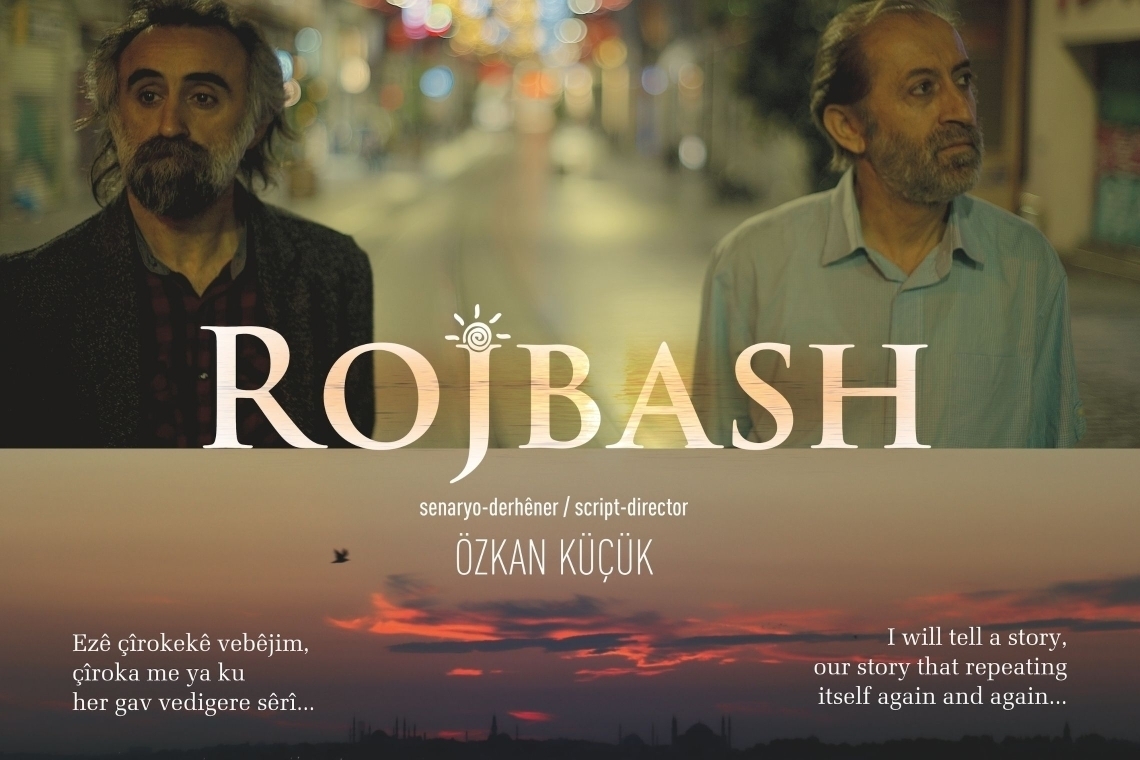
- The 10th Administrative Case Chamber of the Ankara Regional Administrative Court lifted the decision of the Ankara 3rd Administrative Court that had removed the ban on the Rojbash film.
- The chamber accepted the appeal application of the Ministry of Culture and Tourism and rejected the case; it also did not accept the material and moral compensation requests of Özkan Küçük.
- MLSA Co-Director Veysel Ok said, “What the appeals court calls ‘social sensitivity’ is clear: Kurdish. This decision, which brings back the ban, reflects a discriminatory approach.”
MLSA – In the case filed against the ban decision given about the Kurdish-language film Rojbash, directed by Özcan Küçük, the appeals court announced its decision. The 10th Administrative Case Chamber of the Ankara Regional Administrative Court lifted the decision of the Ankara 3rd Administrative Court, which had set the film free.
The Ankara 3rd Administrative Court, in the case filed with the legal support of the Media and Law Studies Association (MLSA), had found the administrative ban decision that the film was “not suitable for commercial circulation and screening” to be unlawful and had annulled it; the Ministry of Culture and Tourism had appealed the decision. The ministry had requested the lifting of the Ankara 3rd Administrative Court’s decision, the complete rejection of the case, and the suspension of the execution of the decision.
The 10th Administrative Case Chamber of the Ankara Regional Administrative Court concluded the case by directly entering into the merits without making a separate decision on the request for suspension of execution.
While the chamber accepted the appeal application of the Ministry of Culture and Tourism, it rejected the application of the film’s director Özkan Küçük, whose defense was undertaken by MLSA.
In the decision, it was stated that there was no unlawfulness in the administrative action that found the film “not suitable for commercial circulation and screening.”
Emphasis on “social sensitivities” and “polarization”
In the court decision, it was argued that some scenes and dialogues in the film “did not observe social sensitivities” and had a quality that “could lead to polarization in society.”
In addition, in the decision, evaluations were also included that in the film, “a perception is created that the fight against terrorism carried out against the PKK is unjust” and that “the struggle carried out by the state is discredited.”
In line with these evaluations, the chamber concluded that the decision of the Evaluation and Classification Board, which did not find the film suitable for screening, was in accordance with the law.
Compensation requests were also rejected
The court also rejected Özkan Küçük’s requests for 100,000 TL material and 400,000 TL moral compensation on the grounds that there was no unlawfulness in the action subject to the case. It was decided that litigation expenses and attorney fees would be left on the plaintiff.
An appeal to the Court of Cassation is open within 30 days against the decision.
Veysel Ok: “The decision itself is discriminatory”
MLSA Co-Director Veysel Ok, in his evaluation regarding the decision, said, “What the appeals court calls ‘social sensitivity’ is clear: Kurdish. This decision, which brings back the ban on the grounds that it ‘would lead to polarization in society,’ itself reflects a discriminatory approach.”
Reminding the defense presented by MLSA, Ok said, “What we have said from the very beginning in this file was very clear: a complete banning of a work is the heaviest intervention and can only be considered if a concrete, clear danger can be put forward. However, the justifications put forward in this file consist of abstract evaluations.”
Saying that “the first instance court also identified this and put forward that lighter measures instead of banning were possible,” Ok stated that the appeals decision did not observe this balance.
Ok also said, “Such a ban not only prevents the screening of a film; it continues the intervention against freedom of expression and artistic freedom, and this damage cannot be compensated later. The court did not take this aspect into consideration at all.”
What had happened?
The Ministry of Culture and Tourism in 2024 gave a decision that the film Rojbash, directed by Özkan Küçük, was “not suitable for commercial circulation and screening,” and thus effectively banned the film.
Thereupon, with the legal support of MLSA, a case was filed. The Ankara 3rd Administrative Court, with its decision given at the beginning of 2026, ruled that the ban was unlawful and annulled the action. The court emphasized that lighter measures such as classification were possible instead of banning and ruled in favor of freedom of expression and artistic freedom.
However, the Ministry of Culture and Tourism carried this decision to appeal and requested the suspension of the execution of the decision.
MLSA lawyers, in their defense submitted during the appeal process, stated that the suspension of execution would mean the film being effectively banned again and that this would cause irreparable damage to freedom of expression and artistic freedom. In the defense, it was also emphasized that the ban was disproportionate and that a balance could be established with lighter measures.