

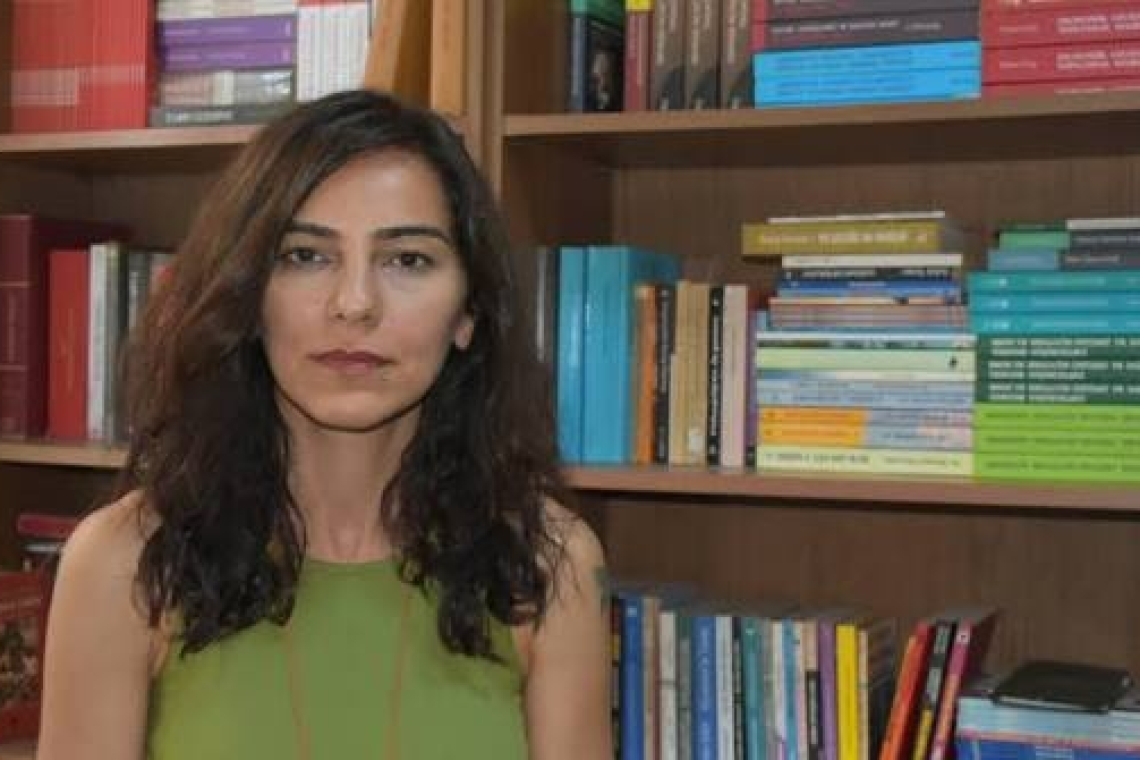
- Lawyer Sezin Uçar, who had been held in pretrial detention for about six months on charges of “membership in the MLKP,” was released at her first hearing under a travel ban.
- “I do not accept the charges as presented in the indictment. I am proud to have practiced my profession until now, and I stand behind my actions and activities,” Uçar said in her defense statement.
- Mustafa Tezel, a witness whose statements were cited in the indictment against Uçar, denied making the statement attributed to him and said his testimony had been obtained under pressure.
- “I did not give such a statement,” Tezel told the court.
- The court ordered Uçar’s release subject to a ban on leaving Turkey.
- The MLKP, or Marxist-Leninist Communist Party, is a militant organization that Turkey designates as a terrorist group.
Semra PELEK
ISTANBUL — A Turkish court ordered the release of lawyer Sezin Uçar, who had been held in pretrial detention for about six months on a charge of “membership in the MLKP,” at her first hearing before the Istanbul 26th High Criminal Court.
Uçar denied the charge. Mustafa Tezel, a witness whose statement was included in the indictment, told the court that he did not know Uçar, had no knowledge of the allegations against her and had not given the statement previously attributed to him.
At the end of the hearing, the court ordered Uçar’s release subject to a ban on leaving Turkey.
Istanbul Bar Association President İbrahim Kaboğlu and members of the association’s executive board attended the hearing, along with representatives of the International Observatory for Lawyers in Danger, numerous lawyers and Meral Danış Beştaş, a lawmaker from the pro-Kurdish Peoples’ Equality and Democracy Party, or DEM Party.
Because of the large number of observers, the courtroom of the Istanbul 24th High Criminal Court was also opened to people seeking to follow the proceedings in addition to the courtroom of the 26th High Criminal Court.
Uçar, who had been held at Bakırköy Prison in Istanbul, was brought to the courtroom for the hearing. After a change in the panel of judges was announced, the charge against her and the three-page indictment were summarized.
The indictment was based on statements from 13 people who had invoked Turkey’s “effective remorse” provisions, which can allow suspects or defendants accused of certain offenses to receive reduced sentences or other legal benefits in exchange for providing information or cooperating with authorities.
‘I do not accept the charges’
Uçar began her defense statement by thanking her colleagues and legal organizations for supporting her during her six months in pretrial detention.
She denied the allegations in the indictment.
“I do not accept the charges as they are presented in the indictment. I am otherwise proud to have practiced my profession all these years, and I stand behind my actions and activities,” Uçar said.
Uçar said her professional activities had been treated as grounds for criminal charges and that she did not accept that they constituted criminal conduct. She said she had been a lawyer registered with the Istanbul Bar Association for 20 years and noted that even press statements held outside Istanbul’s Çağlayan Courthouse had been cited among the allegations against her.
Uçar said that, as a socialist woman lawyer, she had followed cases involving social and political issues.
“I do not see the struggle for justice as confined to courtrooms. I regard the struggle for rights and freedoms as a fundamental part of practicing law,” Uçar said, adding that the indictment was based on statements from cooperating witnesses.
Uçar said such statements had increasingly been used in political cases and prosecutions targeting lawyers in recent years, and objected to their use as evidence.
‘Statements by people who accuse others out of fear cannot be evidence’
Uçar said the reliability of statements made by people who had invoked effective remorse provisions should be assessed.
Saying she was being prosecuted on the basis of statements from such individuals, Uçar said she rejected being tried on allegations made by “people who, captive to their cowardice, signed documents put in front of them and lost their sense of self.”
Uçar said fear was a human emotion but argued that statements from people who falsely accused others because they were afraid should not be admitted as evidence.
“But I do not accept statements by people who falsely accuse others out of fear being used as evidence. I do not consider this lawful or ethical,” she said.
Uçar also cited rulings by Turkey’s Court of Cassation concerning how courts should assess statements made by cooperating witnesses or people who have invoked effective remorse provisions.
‘I will not share the password’
During the hearing, a judge said investigators had been unable to create a forensic image of Uçar’s computer because of its security code and asked whether she would consider providing the password to the court. Uçar said she would not share it because of the confidentiality of her professional and private life, adding that she did not believe doing so would be legally appropriate.
Uçar also described conditions at Bakırköy Prison, saying 60 people were being held in a ward designed for 35 and that two people were sharing each bed. She said those held in the ward included journalists, people arrested ahead of the NATO summit, fellow lawyers and people involved in struggles for social freedoms.
Uçar said she had returned to Turkey from France, where she had traveled for work, despite knowing that she would be arrested upon her return.
“What matters is not my freedom, but the decision you make is important,” she said.
Uçar said there was no risk that she would flee or tamper with evidence and asked the court to release and acquit her.
Witness says: ‘I don’t know, I don’t remember’
Mustafa Tezel, a witness named in the indictment against Uçar, testified at the hearing and said he did not know her. Asked what he knew about the allegation that Uçar was a “member of the MLKP,” Tezel replied, “I don’t know.”
Tezel also said he did not remember the statement he was alleged to have previously given. The judge then read aloud in the courtroom the statement that Tezel was said to have given during the investigation.
“I did not give such a statement. The statement is not accurate,” Tezel said.
Tezel was also asked whether Uçar had participated in a Google Meet meeting cited as part of the case against her.
“I don’t remember whether the defendant attended the meeting either. How would I know?” he replied.
Uçar’s lawyer asked Tezel whether he had previously been tried on an offense related to membership in an organization and whether he had been subjected to pressure while his statement was being taken.
Tezel said he had previously been tried on an organization-related charge and added: “I was pressured when this statement was taken.”
Prosecutor seeks continuation of Uçar’s detention
Istanbul Bar Association President İbrahim Kaboğlu also addressed the court at the hearing. Kaboğlu said he would not address the substance of the defense and would instead assess Uçar’s detention from his perspective as a constitutional law scholar.
Citing Article 19 of Turkey’s Constitution, Kaboğlu said the principle of proportionality must be observed when ordering pretrial detention.
Serhat Çakmak, one of Uçar’s lawyers, said the case duplicated another set of proceedings. Çakmak said there was another ongoing case against Uçar involving the same allegations and argued that the emergence of new evidence did not necessarily require a new investigation.
Çakmak argued that the requirements for pretrial detention under Article 100 of Turkey’s Code of Criminal Procedure, or CMK, had therefore not been met. Article 100 requires concrete evidence indicating strong suspicion that a crime has been committed, as well as grounds justifying pretrial detention.
The prosecutor, however, asked the court to keep Uçar in pretrial detention.
The panel of judges recessed the hearing to consider its decision. After the recess, the court ordered Uçar’s release subject to a ban on leaving Turkey.
The trial was adjourned until 2:15 p.m. on Jan. 19, 2026.