

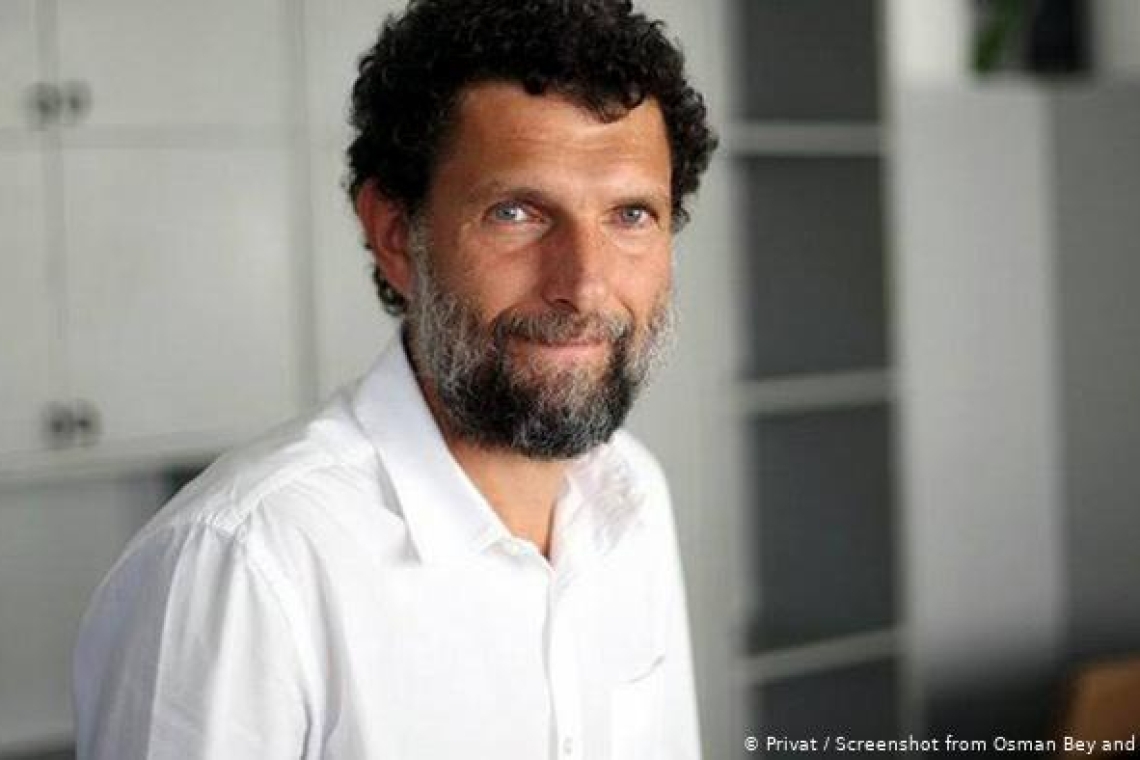
The European Court of Human Rights (ECHR) has accepted an application by the Media and Law Studies Association (MLSA) to participate as a third party in the second case brought by jailed Turkish businessman and human rights defender Osman Kavala against Turkey.
In a letter sent to MLSA by the presidency of the court’s Grand Chamber, the ECHR said the association would be allowed to submit written observations in Kavala v. Turkey (No. 2). Under the timetable set by the court, MLSA must file its intervention — limited to 10 pages and focusing on general legal principles relevant to the case — by Feb. 12, 2026. The observations will also be shared with the parties, who will be able to respond to them at a public hearing scheduled for March 25, 2026.
Veysel Ok, co-director of MLSA, welcomed the decision, describing the Kavala case as one of the most significant files for Turkey in terms of freedom of expression and the right to liberty.
“The acceptance of MLSA’s participation in the Osman Kavala application, which is among the most important cases for Turkey in terms of freedom of expression and personal liberty, is extremely important,” Ok said. “There has already been a violation ruling by the Grand Chamber. As MLSA, we will both submit our written intervention and attend the hearing. Our hope is that Osman Kavala will regain his freedom as soon as possible.”
Kavala, a prominent philanthropist and civil society figure, has been imprisoned since 2017 on accusations of organizing the nationwide Gezi Park protests and attempting to overthrow the government. He has remained behind bars despite a 2019 ECHR ruling that found his pretrial detention violated his rights to liberty and security as well as freedom of expression and association, and concluded that his detention was politically motivated.
After Turkey failed to implement that judgment, the case was taken up by the Council of Europe’s Committee of Ministers, which oversees the execution of ECHR rulings. An infringement procedure was subsequently launched, and the case returned to the ECHR’s Grand Chamber, which ruled that Turkey had failed to fulfill its obligation to comply with the court’s decisions.
Despite that finding, Kavala was not released. In September 2023, Turkey’s Court of Cassation upheld an aggravated life sentence handed down by a lower court. Following the finalization of that conviction, Kavala lodged a new application with the ECHR, alleging violations of his right to a fair trial and his freedoms of expression and association. The court communicated the application to the Turkish government in 2024.
The ECHR’s seven-member Second Section later relinquished jurisdiction, saying the case raised a “serious question” regarding the interpretation or application of the European Convention on Human Rights, and referred it to the 17-judge Grand Chamber for a final ruling.
Legal experts say that if the Grand Chamber again finds a violation, Turkey’s argument that Kavala is now being held as a “convicted prisoner” and that previous judgments have therefore been complied with would lose its validity.
The Grand Chamber is expected to deliver its final judgment after the March 25 hearing.