

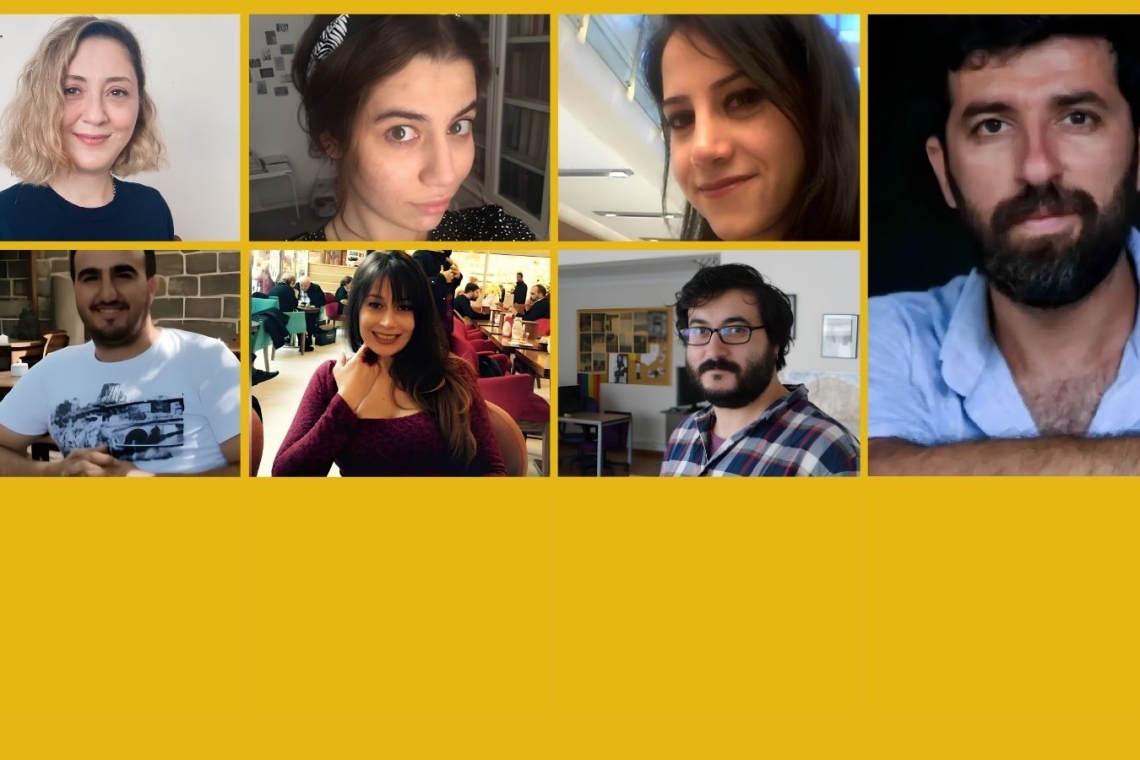
- An indictment was prepared against journalists who were detained in June last year and taken by road to Artvin, a 25-hour journey.
- The investigation was launched by the gendarmerie without an order from a prosecutor. The indictment prepared by the Artvin Chief Public Prosecutor’s Office was sent to Istanbul by the Artvin High Criminal Court after it issued a ruling that it lacked jurisdiction.
- In the indictment, journalists’ meetings with lawmakers and lawyers, receiving royalties for translations, using the Signal app and even “possibilities” were treated as evidence of a crime.
- The trial, accepted by the Istanbul 26th High Criminal Court, will begin on Nov. 24
CANAN COŞKUN
The Artvin Chief Public Prosecutor’s Office prepared an indictment against journalists Semra Pelek, Eylem Emel Yılmaz, Dicle Baştürk, Metin Yoksu and Yavuz Akengin, translator Melisa Efe and website developer Ozan Cırık on charges of “membership in an organization.” In the indictment, the “date of the offense” was listed as June 13, 2025, the day the journalists were referred to the prosecutor’s office, while the “place of the offense” was listed as Artvin. However, the Artvin High Criminal Court sent the case file to Istanbul on the grounds that it “lacked jurisdiction.”
They were taken to Artvin in custody after a 25-hour journey
The journalists facing trial were detained by the Artvin gendarmerie on June 13 last year and taken to Artvin by road in a journey that lasted 25 hours.
After four days in police custody, journalists Eylem Emel Yılmaz, Dicle Baştürk and Yavuz Akengin, as well as Ozan Cırık, were arrested on June 16 and remained in prison for about a month. A statement by the DİSK Basın-İş union revealed that Yılmaz was not given a bed while being held at Artvin Closed Prison and was forced to sleep on the floor on top of a blanket.
Journalist Metin Yoksu was arrested at the Batman courthouse on June 26 after going there to give a statement as part of the investigation.
Speaking with bar association president, journalists and lawmakers treated as evidence of a crime
During their questioning by the gendarmerie, the journalists were asked about phone calls they had with journalists, lawmakers, representatives of journalism professional organizations, lawyers and rights defenders.
A note stating “wanted” had also been entered for Erol Önderoğlu, the Turkey representative of Reporters Without Borders (RSF), with whom the journalists had been in contact.
Among those the journalists had spoken with by phone were journalist Hasan Cemal; Faruk Eren, former chair of the DİSK Basın-İş union; forensic medicine expert Şebnem Korur Fincancı; human rights lawyer Mehmet Raci Bilici; lawyer Hürrem Sönmez, a member of the Istanbul Bar Association’s executive board; then-HDP lawmakers Oya Ersoy, Tayip Temel and Tuma Çelik; and İbrahim Özden Kaboğlu, who was a CHP lawmaker at the time and is now president of the Istanbul Bar Association.
Seven pages describe coup attempt, but no connection is established
A Feb. 14, 2025, report by the Financial Crimes Investigation Board (MASAK) treated the royalties the journalists received for their news reports and translations as evidence of a crime.
The first seven pages of the 39-page indictment prepared by the Artvin Chief Public Prosecutor’s Office describe events during the July 15, 2016, coup attempt. After stating that the Bosphorus Bridge was closed, the Turkish Parliament was bombed and F-16 fighter jets flew at low altitude over the General Staff headquarters and the General Directorate of Security, the indictment discusses the objectives of the Gülen movement, which Turkish authorities designate as FETÖ and the organization’s hierarchical structure.
Without establishing any connection between the events during the coup attempt and the accused journalists, the indictment alleged that the journalists were part of the structure of the FETÖ/PDY armed terrorist organization.
No prosecutor’s order, gendarmerie investigated on its own
According to the indictment, the investigation began with an open-source inquiry conducted by the Counterterrorism Branch of the Artvin Provincial Gendarmerie Command without any instruction from a prosecutor’s office.
The authority to initiate and conduct a criminal investigation belongs to the public prosecutor. Law enforcement authorities, meaning the police and gendarmerie, are tasked with carrying out investigations in line with the prosecutor’s orders and instructions. For this reason, it is not legally possible for the gendarmerie to launch an investigation on its own without a prosecutor’s instruction. The indictment revealed that the Artvin investigation was initiated by the gendarmerie without such an instruction.
As part of its work, the gendarmerie reported that journalist Sevinç Özarslan, who has an arrest record in the Interior Ministry’s “gray category,” had attended events abroad organized by the Gülen movement, that her news reports were published both on her own platform and on a website called Kronos, and that the Kronos website contained content concerning people linked to the Gülen movement. The gendarmerie report stated that Doğan Ertuğrul, Turhan Bozkurt and Selahattin Sevi were among the founders, editors and writers of Kronos, and alleged that these individuals collected money from people in Turkey and abroad under the name of “support,” transferred the money into Turkey and used it to prevent people with no financial income from breaking away from the organization. The gendarmerie then sent this report to the Artvin Chief Public Prosecutor’s Office.
Royalties paid for news translations treated as evidence of a crime
While in custody, the journalists faced accusations related to the Kronos website.
Journalist Semra Pelek, MLSA’s Trial Coordinator, said she had been working as a journalist for 28 years and had worked throughout her career as a court reporter and politics editor for mainstream newspapers and magazines including Milliyet, Akşam and Tempo. She said she had worked with Selahattin Sevi at the Milliyet newspaper when it was owned by Aydın Doğan, and that at the time Sevi worked as a motorcycle courier-photographer in Milliyet’s Photo Department.
Pelek said that during the pandemic, as an unemployed journalist, she had to constantly find new work so she could work from home and support herself, taking on many different freelance and piecework jobs. She said she earned her living primarily by translating from German into Turkish during this period, adding that children’s books she translated for Kırmızı Kedi Çocuk Yayınları were also published at the time.
Pelek said that during this period Sevi called her and told her about a website he was planning to launch focused on photography, and asked whether she could translate news reports published in the German press from German into Turkish for payment as part of the website’s preparations. Pelek said she translated news reports published in the German press into Turkish and sent them to Sevi, adding that the payments she received at the time from the Free Journalist Association were royalties for those translations. In her statement, Pelek said, “There is nothing suspicious about the name of the Free Journalist Association, and it is not possible for me to know the criminal records of the members of its executive board.”
Pelek said she had also worked with Doğan Ertuğrul at Tempo magazine, which was also owned by Aydın Doğan, during the same period and that she knew Ertuğrul through that work. She said she did not know the other members of the Free Journalist Association’s executive board.
According to prosecutor, ‘possibility of working for Kronos’ is evidence
The indictment presented no concrete evidence showing that Pelek worked for Kronos or published any bylined news reports on the website.
The prosecutor treated the possibility that Pelek might work for Kronos as grounds for an accusation. The indictment alleged that Pelek said, “Just as I work for anyone, I could also work for Kronos.” However, no such sentence appears in Pelek’s statement. Pelek was therefore accused on the basis of a “possibility of working” that was not shown to have materialized and a sentence that does not appear in her statement.
Speaking with journalists also became grounds for accusation
During her questioning by the gendarmerie, Pelek was asked about phone calls she had with journalists Nadire Mater, Hasan Cemal, Erol Önderoğlu, Faruk Eren, Evrim Kepenek, Diren Yurtsever, Seyhan Avşar, Hayri Demir, Ozan Kaplanoğlu, Aziz Oruç, Ruşen Takva, Mimar Kaya and Ramazan Yılmaz, as well as lawmaker Leyla Güven.
It was stated that these individuals had records in the gendarmerie system for the offenses of “membership in an armed terrorist organization” and “making propaganda for a terrorist organization.” No information was provided about the outcomes of those cases.
Pelek said she was the Trial Monitoring Coordinator at the Media and Law Studies Association (MLSA), that speaking with journalists and politicians who had been prosecuted in cases concerning freedom of expression was part of her job description, and that she would continue speaking with people facing such cases.
Phone calls with her lawyer also treated as evidence for the accusation
Pelek was also questioned about phone calls she had with her lawyer, Hürrem Sönmez, who was the secretary-general of the Istanbul Bar Association at the time. Sönmez was then standing trial alongside Istanbul Bar Association President İbrahim Kaboğlu and members of the association’s executive board in a case brought over the bar association’s statement concerning journalists killed in Syria.
Sönmez, one of the lawyers who represented Pelek before the duty court while she was in custody, together with MLSA Legal Unit lawyer Didare Hazal Sümeli, objected to their conversations being presented as evidence of a crime. Addressing the duty judge, he said, “My client’s speaking with me has been presented as if it were evidence of a crime, but look, I am here before you,” and reminded the court of the presumption of innocence.
On Jan. 9, 2026, the Istanbul 26th High Criminal Court acquitted 10 executive board members, including Kaboğlu and Sönmez. The journalists who were taken to Artvin will now also stand trial before the Istanbul 26th High Criminal Court.
Skype and Signal treated as evidence of a crime
Ordinary communication records found during an examination of Pelek’s seized computer and phone were also made part of the accusations.
The indictment presented as if it were evidence of a crime the fact that a link for a call sent to Pelek via Skype had also been sent to Doğan Ertuğrul, Selahattin Sevi and Armenian journalist Alin Ozinian. The indictment did not include any record of that call.
Similarly, the fact that German citizen, screenwriter and director Bülent Gençdemir sent Pelek a link to the Signal app was also included in the indictment. The prosecutor alleged that FETÖ members used Signal instead of ByLock.
However, Gençdemir was a director with whom Pelek had worked on a documentary for German public broadcaster ZDF in 2025. The three-part documentary series examined how Turkish law enforcement authorities and the judiciary solved the killings of German tourists in Antalya and Alanya. The Signal link Gençdemir sent Pelek during filming was treated as evidence of a crime, independently of this professional communication.
Although the indictment contains no finding that Gençdemir was a member of FETÖ, the fact that he sent a Signal link was considered evidence against Pelek.
Another suspect named in the indictment is translator Melisa Efe. Efe said she was familiar with neither the association called Free Journalist nor the Kronos website. The Signal messaging app installed on Efe’s phone was also made part of the accusations against her.
Journalism and news website editing made part of the accusations
Another journalist accused in the indictment, Yavuz Akengin, said in his defense statement that he had worked as a reporter at the Zaman newspaper from 2013 until trustees were appointed to the newspaper in 2016, and that he later had to take on various freelance jobs for which he was paid royalties.
Akengin said that, at the suggestion of Selahattin Sevi, whom he knew from Zaman, he began working for the Kronos news website in 2020 in exchange for royalties, worked there as an editor and also submitted news reports for a period to a website called Velev.
Journalist Dicle Özarslan also said she worked as an editor for the Kronos news website and that the payments she received for the news reports she produced there were sent by an association abroad called Free Journalist. Özarslan said she left that job in January 2025 and had also worked briefly in 2023 for websites founded by journalist Yavuz Baydar. It was alleged that lawyer Efkan Bolaç, one of the people Özarslan had spoken with by phone, was the subject of an arrest warrant on a charge of “making propaganda for a terrorist organization.”
Journalist Eylem Emel Yılmaz said she worked for the Ahval website between 2018 and 2019, saw a job posting for a reporter at the Kronos news website in 2019 and began working there in 2020 after speaking with Doğan Ertuğrul. Yılmaz said she also prepared interviews and news reports for the websites Journo, Yeşil Gazete, Euronews Türkçe and Independent Türkçe in exchange for royalties.
Standing trial over a job he did not accept
Journalist Metin Yoksu also said he had produced several news reports for the Kronos website in exchange for royalties, and that Selahattin Sevi had offered him a job, but he did not accept it because the working arrangement was not suitable for him.
Metin Yoksu, who is particularly known for his reporting on environmental and ecology issues, works as a freelance journalist.
Another person who will stand trial in the case is website developer Ozan Cırık.
Cırık said that after speaking with Doğan Ertuğrul in 2018, he agreed to maintain the Kronos website and work on problems that arose, and that this work ended in early 2025.
Cırık had taken part in relief efforts for earthquake victims following the Maraş earthquakes in February 2023. During Cırık’s questioning by the gendarmerie, the 300 Turkish lira he had sent to volunteers was entered into the case file as evidence of a crime.
First hearing set for Nov. 24
The indictment, which was sent to Istanbul by the Artvin High Criminal Court after it ruled that it lacked jurisdiction, was accepted by the Istanbul 26th High Criminal Court.
The first hearing in the case will be held on Nov. 24.
Judicial control measures imposed on the journalists since June 2025, including a ban on traveling abroad and a requirement to regularly report and sign in, have not been lifted despite objections.
The MLSA Legal Unit, which is representing Semra Pelek and Yavuz Akengin, filed an application with the Constitutional Court seeking remedies for the violations of the journalists’ rights.