

Rabia Çetin
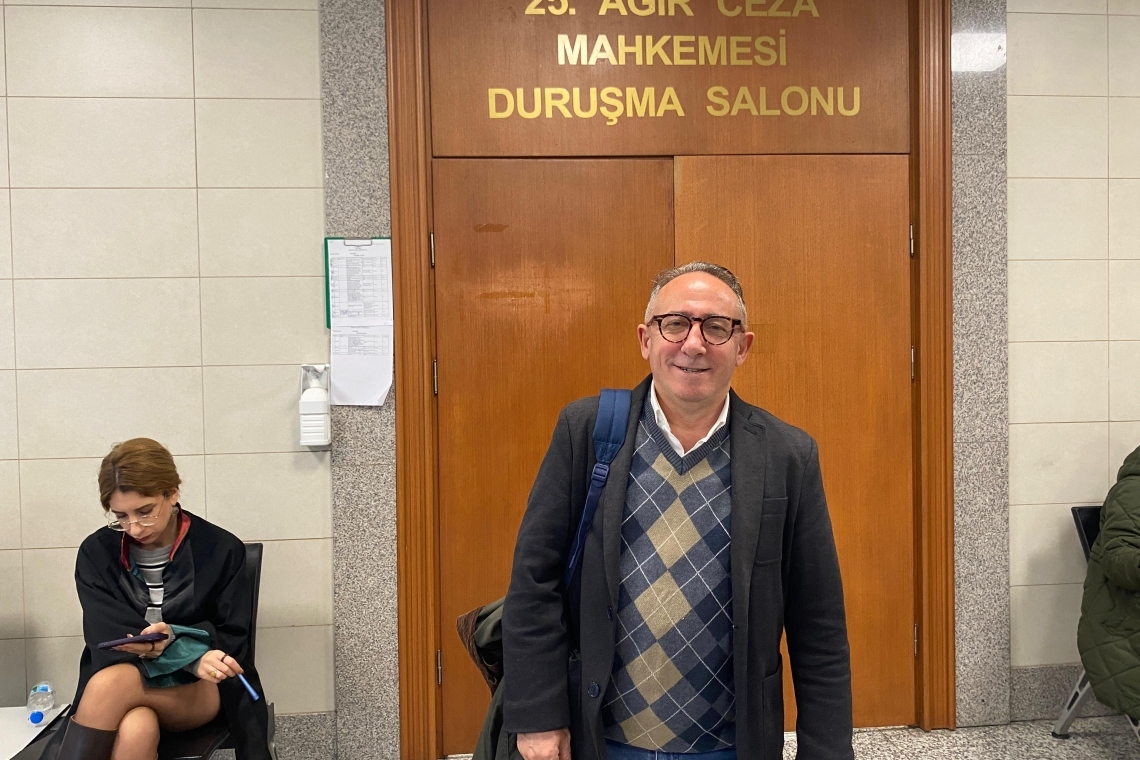
Turkish journalist Murat Aksoy was acquitted on Monday in the second hearing of a retrial held after the Constitutional Court ruled that his rights had been violated. Aksoy had been charged with “knowingly and willingly aiding a terrorist organization” but was cleared of the accusation by the Istanbul 25th High Criminal Court.
Aksoy and his lawyer, Ali Deniz Ceylan, attended the hearing, where the court delivered its decision following defense statements. In the previous session, the prosecutor had reiterated his opinion that Aksoy had committed the crime and had requested that the earlier conviction be upheld.
In his defense statement, Aksoy declared the case “already closed” for him. “I served more time than the sentence I was given and had my rights restored,” he said, referring to his initial detention in 2016 on charges of aiding a terrorist group without being a member. “This case started on August 30, 2016. I was arrested on September 3, 2016, and charged with aiding a terrorist group. The indictment, issued 5.5 months later, charged me with membership. My first hearing took place 210 days after my arrest.”
Aksoy added that the prosecutor had initially asked for his release, and the court agreed. However, the night before his scheduled release, a new investigation was launched against him for “attempting to overthrow the constitutional order,” and he was detained again, later re-arrested after 14 days in custody. He was eventually acquitted of the membership charge but sentenced on February 18, 2018, for aiding the organization, based on time already served.
“I have been a journalist for 30 years and continue to write. None of my articles or statements have led to any other legal cases,” he said. “The Constitutional Court ruled that my punishment was due to my articles and public statements, which it deemed journalistic activity, not a crime. I have argued this from the very beginning.”
“I wrote and spoke out because I want to live in a fairer, freer, and more democratic country,” Aksoy continued. “I want my children, and all children, to grow up in such a country. That’s why I will continue to write and speak. I request my acquittal.”
Defense attorney Ali Deniz Ceylan emphasized that the entire case was based on Aksoy’s writings and tweets. “He was previously tried under articles 309 and 312 [of the Turkish Penal Code] for the same allegations and acquitted. He exercised his right to freedom of expression and freedom of the press. No new evidence has been added to this case since 2016. This trial must come to an end.”
Ceylan also criticized the prosecution’s decision to repeat its previous opinion, ignoring the Constitutional Court's ruling. “In the last hearing, the prosecution acted as if the Constitutional Court’s decision didn’t exist and simply repeated the earlier opinion. We believe that opinion is not legally sound,” he said.
“The Constitutional Court directly examined the substance of the case and found that the evidence must be assessed within the framework of freedom of expression,” he continued. “No new evidence has emerged in the past 10 years. We cannot understand how a sentence can be requested under these conditions. Any outcome other than acquittal would not remedy the violation found by the Constitutional Court. There is no legal basis for applying article 220/7 of the penal code or any other charges under retrial conditions. We request acquittal in line with the Constitutional Court’s ruling.”
After a recess following Aksoy’s final remarks, the court acquitted him, with the right to appeal the verdict.
Background on the case
The Constitutional Court had ruled that Aksoy’s rights to freedom of expression and freedom of the press were violated when he was sentenced to 1 year and 13 months in prison over his opinion pieces, social media posts, and television appearances. The court ordered a retrial and awarded Aksoy 55,000 Turkish liras (approximately $1,900) in compensation. Aksoy had spent 15.5 months in pre-trial detention.
The Constitutional Court found that the lower court failed to provide a relevant and sufficient justification for concluding that Aksoy had knowingly aided the Gülen movement—referred to by the Turkish government as FETÖ/PDY and designated a terrorist organization—without being part of its hierarchical structure. It also emphasized that interference with Aksoy’s freedom of expression and the press did not meet the requirements of a democratic society.
The ruling criticized the original verdict for lacking clarity and context, noting that the court had not sufficiently examined Aksoy’s journalistic background or explained why certain writings and social media posts were considered incriminating. It also highlighted that Aksoy’s payments from media outlets not yet shut down at the time, and his communications with individuals possibly working at those outlets, could not be considered criminal.
In particular, the court said there was no information in the investigation or trial files to support claims that Aksoy had aimed to legitimize the organization in his TV appearances, which the lower court cited as part of the reasoning for his sentence.