

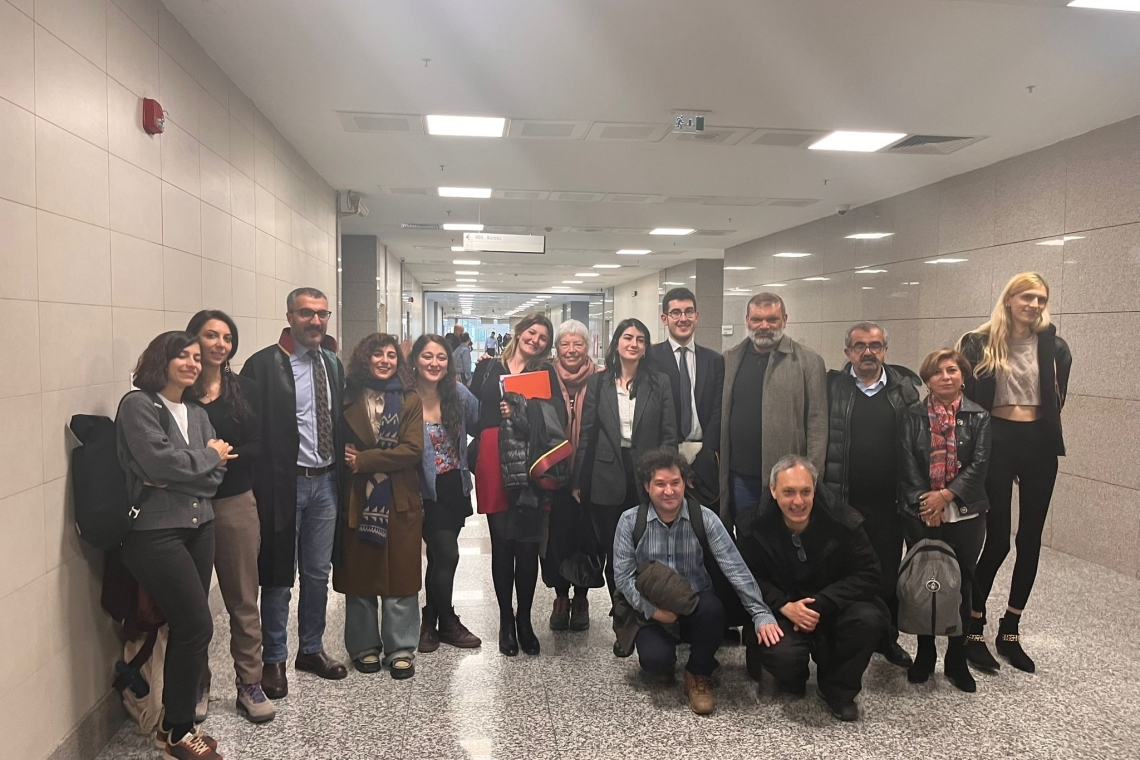
MLSA - Seven journalists and media workers went on trial in Istanbul on Monday over allegations of “aiding a terrorist organization,” stemming from their paid contributions to two Germany-based publications. The defendants rejected the charges and described the case as an attack on press freedom.
The first hearing of the case, held at the Istanbul 13th High Criminal Court, lasted more than two hours and started later than scheduled. The defendants—journalists Erdoğan Alayumat, Tuğçe Yılmaz, Suzan Demir, Gülcan Dereli, Kemal Taylan Abatan, translator Serap Güneş, and sociologist Berfin Atlı—face charges based on freelance articles and translations they produced for Yeni Özgür Politika, a newspaper based in Germany, and its culture and arts supplement PolitikArt.
The indictment is based on social media content and a financial report prepared by Turkey’s Financial Crimes Investigation Board (MASAK), the court said. Prosecutors claim that the payments the journalists received constitute support for a terrorist organization. The accused say they were simply paid for freelance journalistic work.
“I’m being tried for receiving €777”
Sociologist Berfin Atlı opened her defense by expressing disbelief at the charges. “I’ve written freelance pieces for various outlets. I’m being prosecuted for receiving €777 in royalties—an amount that doesn’t even cover a single woman’s rent in Istanbul,” she said. “I stopped writing for the outlet because it wasn’t financially sustainable.”
“If getting paid for journalism is a crime, how can anyone work?”
Journalist Erdoğan Alayumat, a long-time reporter, said his journalism has long been criminalized. “I’m being prosecuted for royalties I received for a news report. There is no organizational connection,” he said. Referring to the inclusion of his social media posts in the case, he added: “This is a trial of journalism. If writing news and getting paid for it is considered a crime, how can anyone do journalism? Should I work for free?”
“Royalties are not a crime”
Gülcan Dereli, another journalist on trial, said she regularly contributes freelance articles to various outlets. “Producing news and receiving royalties is not a crime,” she said. When asked by the judge about a witness who claimed she had written for Yeni Özgür Politika, Dereli responded: “I contribute to many outlets, not just that one. I do not accept the witness statement. Articles are published by those who accept and pay for them.”
Journalist Kemal Taylan Abatan also rejected the charges, saying he relied on his freelance journalism income to make a living and called for his acquittal.
Translator Serap Güneş stated she only performed translation work in exchange for royalties and denied the allegations and the testimony against her.
Suzan Demir said she has worked as a film critic since 2008 and identifies as a journalist. She also denied all charges.
“This case tells us we can only work for the state news agency”
Tuğçe Yılmaz criticized the financial difficulties facing freelance journalists, saying, “Journalists here [in mainstream media] earn 30,000 to 40,000 Turkish liras. For us to survive, we need to produce freelance work.” She also claimed that she and others were tortured in custody and are still facing violence. “I’m being prosecuted for allegedly joining a group that has already dissolved. It’s ironic,” she said. “This case is basically telling us, ‘You can only work for Anadolu Agency.’”
Witness admits lack of knowledge about article content
A public witness, Büşra Özer, testified that she knew Gülcan Dereli through a former partner and was aware she wrote for Yeni Özgür Politika, but admitted she had no knowledge of the actual content of Dereli’s work.
Defense lawyers say case lacks legal basis
Defense lawyers argued that the indictment contains no criminal elements and referenced rulings by the European Court of Human Rights (ECHR) and Turkey’s Court of Cassation. They stressed that the evidence presented, including the MASAK report, is insufficient for prosecution.
Hazal Sümeli, from the Media and Law Studies Association (MLSA), representing Erdoğan Alayumat, said her client is an award-winning journalist who works with national and international agencies. “The royalties he received matched the minimum wage at the time. He lived off that income for 15 months,” she said. “He only did his job and was paid for it. There’s no voluntary support to any organization, which is a legal requirement for the charge. Besides, the organization in question has since dissolved.”
Attorney Batıkan Erkoç from MLSA added: “These people are being prosecuted for being paid by a Germany-based newspaper. If the claim is that they received money from a group sympathetic to a terrorist organization, then where’s the crime?” He noted the absence of allegedly incriminating article content in the indictment. “If the content isn’t there, then where’s the offense?” he asked. Erkoç also questioned the logic of using official bank payments as criminal evidence: “A terrorist group is, by definition, clandestine. Do they make payments through Ziraat Bank? If so, shouldn’t the bank be prosecuted for earning commission?”
“Traveling with handcuffs for eight hours is torture”
Deniz Yazgan, lawyer for Tuğçe Yılmaz, said the MASAK report does not qualify as legal evidence. She also described irregularities during the detention process, stating that lawyers were not informed and that authorities cited only “verbal instructions” to justify confidentiality measures. Yazgan said her client was transported from Istanbul to the central city of Eskişehir with plastic handcuffs for eight hours, calling it “a clear case of torture.”
She also criticized the prolonged requirement for judicial control through signature check-ins. “The process has now moved to fingerprint scanning, which is a violation of personal data protection laws,” she said.
Court lifts judicial controls, sends case to prosecutor for opinion
The court ruled to lift the judicial control measures requiring regular signature check-ins. It also ordered an inquiry into the status of digital materials seized from the defendants and decided not to hear further witnesses due to the current state of evidence and defense statements.
The case file was forwarded to the prosecution for preparation of the final opinion. The defendants were exempted from attending future hearings. The trial was adjourned until Feb. 17, 2026.