

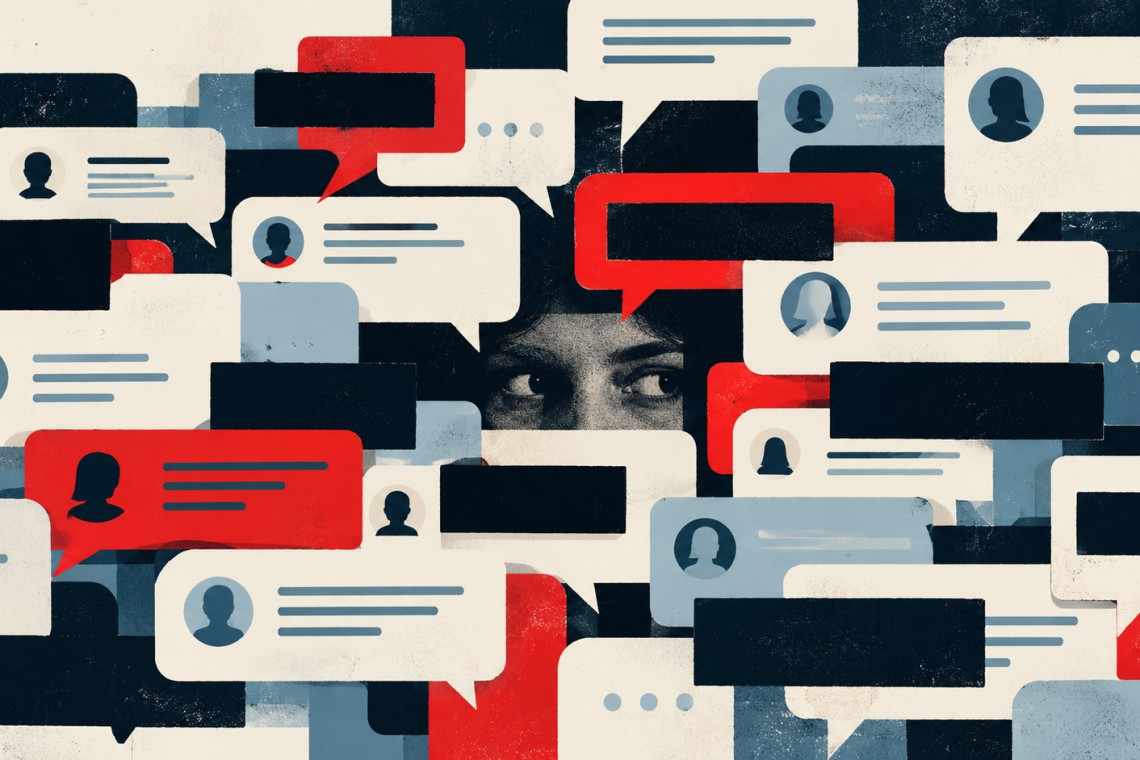
Access restrictions targeting accounts on X in Türkiye have accelerated since September at what observers describe as a “tsunami” pace, with more than 1,200 accounts blocked that month alone. Journalists have been among the main targets.
For journalists who lose access to their X accounts, the consequences extend beyond the accounts themselves. They also lose contact with audiences they have built over years, along with news sources and professional networks that have become central to their work.
In many cases, journalists say they are unable to find anyone who can explain why their accounts were blocked or provide a clear avenue for challenging the decision.
We spoke with journalists whose accounts have been blocked about what they have experienced.
Meral Danyıldız
Restrictions on X accounts in Türkiye have accelerated at an unprecedented pace since September. For journalists, having an account blocked on X no longer means simply losing access to a social media profile. The successive restrictions imposed in recent months have also dismantled follower networks built over years, cut off channels of communication with news sources and removed a key platform journalists use to reach their readers.
At least 1,270 X accounts were blocked in September. About 90% of them were made inaccessible in Türkiye by X. The figure surpassed the 995 accounts blocked under the same scope during all of 2025. The restrictions continued at a rapid pace in October.
The first major wave in September followed operations publicly known as “Ailem Güvende,” or “My Family Is Safe.” During the month, numerous X and Instagram accounts were blocked, including those of the Media and Law Studies Association, or MLSA, Amnesty International Türkiye, Academics for Peace and the Evrensel newspaper.
In the days that followed, accounts publishing news reports and posts about the funding crisis were also targeted with access restrictions.
Journalists whose accounts were blocked over the past two months include Hikmet Adal, Furkan Karabay, Tuğçe Yılmaz, Özlem Akarsu Çelik, Fırat Fıstık, Alican Uludağ, Canan Kaya, Meral Danyıldız, Hamdi Çelikbaş and Yiğit Uzun.
The X accounts of news outlets Kısa Dalga, soL Haber and Mezopotamya Agency were also blocked, along with that of independent news website T24. Access to T24’s website was also restricted. Accounts belonging to Professor Veysel Ulusoy, İnan Mutlu and Emre Şirin, who cover or comment on economic issues, were also made inaccessible to users in Türkiye.
So why are these accounts being blocked?
A significant number of the decisions are based on Articles 8 and 8/A of Law No. 5651, commonly known in Türkiye as the “Internet Law.” Article 8 allows authorities to block access to online content deemed to constitute certain specified crimes. Article 8/A allows internet content or publications to be blocked in cases considered urgent on grounds including national security, public order and the prevention of crime.
But what does the blocking of an account mean for journalists’ day-to-day work?
We asked journalists Onur Dalar, Furkan Karabay and Sarya Toprak, whose accounts have been blocked, how the restrictions have affected their professional activities.
“They’re taking away your livelihood”
Journalist Onur Dalar’s X account has been blocked for a second time. Dalar said the first restriction came during the events surrounding March 19, and that he believes his account was blocked after he shared footage showing police violence against protesters.
“Of course, at a time when social media is so influential, this is a very bad thing for a journalist,” Dalar said, adding that the impact goes far beyond simply shutting down an account.
“For example, I had been thinking about building something around that X account in case I found myself unemployed one day. With the first access restriction, I realized there was no guarantee that I could rely on it. In a way, they’re taking away your livelihood.”
Dalar said he was never given an explanation for why his account had been blocked, leaving him unable to appeal even if he wanted to. He has since given up trying to challenge the restrictions.
“Even if it were the municipal police, there would at least be some explanation. Here, there isn’t even that. With the latest restriction, there was no explanation — I didn’t even get a notification from X. So I opened a new account and didn’t bother pursuing it.
“As a journalist, I also used that account to comment on daily events. People develop a habit of following you there. It’s not something that should be underestimated; I had 10,000 followers. If a politician draws 10,000 people to a rally today, we say that’s a major event. And you lose that audience. You have to start over from scratch. It’s a bad thing.”
“No different from shutting down a newspaper”
Journalist Furkan Karabay said his X account has been blocked multiple times, underscoring the importance of social media accounts to journalists’ work.
He said his account was shut down three times while he was in pretrial detention, and that two newly opened accounts were later subjected to access restrictions.
“It was shut down three times while I was in detention, and afterward access restrictions were imposed twice on the new accounts we opened as well. Most recently, another access restriction was imposed this week,” Karabay said.
For Karabay, blocking journalists’ social media accounts is no different from shutting down a newspaper.
“A significant part of the public follows the news on social media, and X is one of those platforms. So blocking access to a journalist’s X account amounts to depriving the public of its right to receive news,” he said.
Karabay said it is technically possible to open a new account, but doing so does not restore the network built around the old one. Reaching a broad audience again takes time and requires additional work, he said.
“Access-blocking decisions of course create certain difficulties professionally. Just as rebuilding a newspaper involves a set of challenges, opening a new X account as a journalist brings similar problems. It takes time before you can once again get news out to large audiences, and you have to work harder and produce more content.”
How does it affect news sources?
Karabay said opening a new account affects not only a journalist’s follower count but also access to news sources.
“Even if you open a new X account under your own name, a certain segment of people will not be aware of it. As a result, they may not know that a journalist whose X account has been blocked is still sharing news reports on the platform. And because you are reaching fewer people than you did through the blocked account, that also means having access to fewer sources.”
Karabay said the legal process surrounding access restrictions on accounts is not always transparent, describing the way such decisions are issued and enforced as “arbitrary.”
“When our lawyer contacted X officials, we were able to obtain a court ruling in one instance. But we did not receive a response from X after every access restriction. The justification was usually an alleged threat to ‘national security.’ There is an arbitrariness to the process. X’s arbitrary enforcement of arbitrarily issued court rulings is, in fact, no different from the dysfunctional state of the legal system in our country.
“As a result, appeals are already rejected by the competent courts in Türkiye. X then cites the existing ruling as justification and continues to block access.”
She lost a 12-year network with a single decision
Sarya Toprak, a reporter for the BirGün newspaper, said she had used the X account that was blocked since 2014, meaning the restriction wiped out a professional and personal network she had built over 12 years.
“I had been using the same account since 2014. So over 12 years, I had essentially built my own community and communications network there. There were people I followed regularly, spoke with and whose posts I saw. I communicated there with many women’s and LGBTI+ organizations, women activists and academics.”
Toprak described both the access restriction and its impact on her work:
“When the account was blocked, I suddenly lost that entire network. Of course I opened a new account, but rebuilding a network formed over 12 years, reaching the same people again and bringing them together again is not easy at all. So what I lost was not simply a follower count or a social media account; it was the relationships I had built over the years and, in a sense, my own community.
“My news sources also contacted me there. They would message me and send news tips and information. Now I have suddenly lost all of those connections. So the access restriction did not just narrow the space where I could express myself; it directly cut off one of the channels through which I received news and reached my sources.”
Which court, which ruling?
Toprak said she first learned that an access-blocking order had been issued against her account not from X, but through EngelliWeb, a project run by Türkiye’s Freedom of Expression Association, or İFÖD, which monitors online censorship and access restrictions.
Toprak said she had received no notification from the platform at the time. Although X later sent her an email, she said she was still unable to learn which court had issued the order or what ruling was being enforced.
“Later, I received an email from X. But the email did not specify which court ruling it was based on or what the justification was. It only said the account would be blocked on the basis of a court ruling in Türkiye.
“After that, I wrote to X many times. I asked which court ruling they were relying on to block access to my account and what the ruling actually said. I also told them that by enforcing an intervention that I believed was unlawful, they themselves were becoming a party to it. But I received no response to any of the emails I sent. Even today, I have still not been able to learn from X which specific court ruling was used to block my account.”
Toprak said the failure to notify her of the ruling does more than leave her without information; it also makes it more difficult to exercise her right to appeal.
“In order to challenge a court ruling, I first need to know what that ruling is and be able to obtain it. But I do not have a court ruling in my possession. So in practice, exercising your right to appeal is made much more difficult. To be able to appeal, you have to go from courthouse to courthouse trying to find out which court issued the ruling. That alone creates a serious burden in terms of both time and work.”