

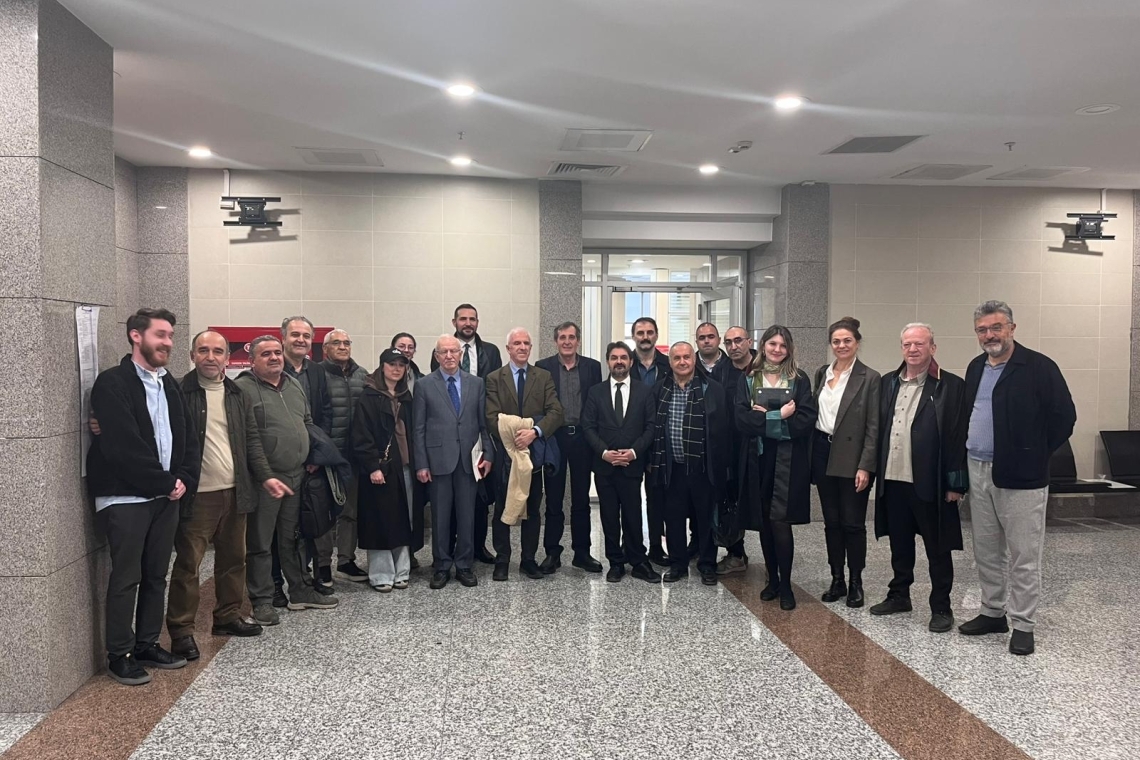
- Journalist Zafer Arapkirli was sentenced to 2 years and 6 months in prison for the crime of “spreading misleading information” within the scope of TCK 217/A.
- In the hearing that started with approximately a 3-hour delay, the court ruled acquittal for the charge of “inciting the public to hatred and hostility.”
İstanbul - The hearing of the case filed against journalist Zafer Arapkirli on charges of “inciting the public to hatred and hostility” and “spreading misleading information” was seen at the Istanbul 23rd Criminal Court of First Instance.
The hearing started with approximately a 3-hour delay due to the court’s workload.
The prosecution authority repeated its previous opinion on the merits and requested that Arapkirli be punished for both charges.
In his defense, Arapkirli did not accept the accusations. Saying, “I will not make a defense against a non-existent crime,” Arapkirli stated that journalists are being put under pressure through the judiciary and that this prevents the public’s right to receive news.
In his defense, Arapkirli said: “I will not make a defense against a crime that does not exist, that has not even been come close to. Here, in the presence of the prosecutor, I want to report a more serious crime: the crime of dragging the public collectively into a deep darkness.” Arapkirli stated that the political власти target independent journalists and prevent the public’s right to receive news, and said, “Journalists are put under pressure sometimes with such cases, and sometimes with the arrest of names such as İsmail Arı, Alican Uludağ, Merdan Yanardağ, Furkan Karabay and Sinan Aygül.”
Lawyer Deniz Yazgan argued that Article TCK 217/A is unconstitutional and defended that the case is of a SLAPP nature. Lawyer Kemal Aytaç said that the posts are within the scope of freedom of expression.
One of Arapkirli’s lawyers, Kemal Aytaç, also argued that Arapkirli was targeted because of his identity as a journalist, stating: “This case is an attack on freedom of press and expression, and at the same time on the public’s right to receive news. A penalty to be given here will have been given to the public’s right to receive news.”
Istanbul Bar Association President İbrahim Kaboğlu also reminded that the hearing, which should have started at 14:00, began with approximately a 3-hour delay, and stated that the workload in the judiciary affects the right to a fair trial.
Kaboğlu also evaluated the charges directed. Recalling recent criticisms by MHP member Fethi Yıldız regarding Article TCK 217/A, Kaboğlu said that they had carried this regulation to the Constitutional Court after its acceptance. Kaboğlu said: “The material and moral elements required for this crime have not emerged. The unconstitutionality of the article continues. As a matter of fact, in the Constitutional Court’s interpretative rejection decision, it was also stated that these elements would not easily occur. Despite this, if a penalty is given, I am ready to apply to the Constitutional Court again.”
The court ruled acquittal in terms of the charge of “inciting the public to hatred and hostility.” Within the scope of the charge of “spreading misleading information,” a reduction was applied and Arapkirli was sentenced to 2 years and 6 months in prison.
In the decision, the deferment of the announcement of the verdict (HAGB) was not applied.
What did MHP member Fethi Yıldız say?
Article TCK 217/A, known to the public as the “disinformation law,” regulates as a crime the act of “publicly spreading information contrary to the truth with the motive of creating anxiety, fear or panic among the public.” The regulation has long been criticized on the grounds that it restricts freedom of expression and the press.
Most recently, MHP Deputy Chair Fethi Yıldız argued that “five conditions must exist together” for the crime to occur. Accordingly:
- The sharing must be contrary to the truth,
- It must be suitable to disturb public peace
- It must be spread publicly,
- It must be related to the country’s internal and external security, public order or general health,
- It must be done with the motive of creating anxiety, fear or panic.
Yıldız argues that if these conditions do not exist together, the crime will not occur.