

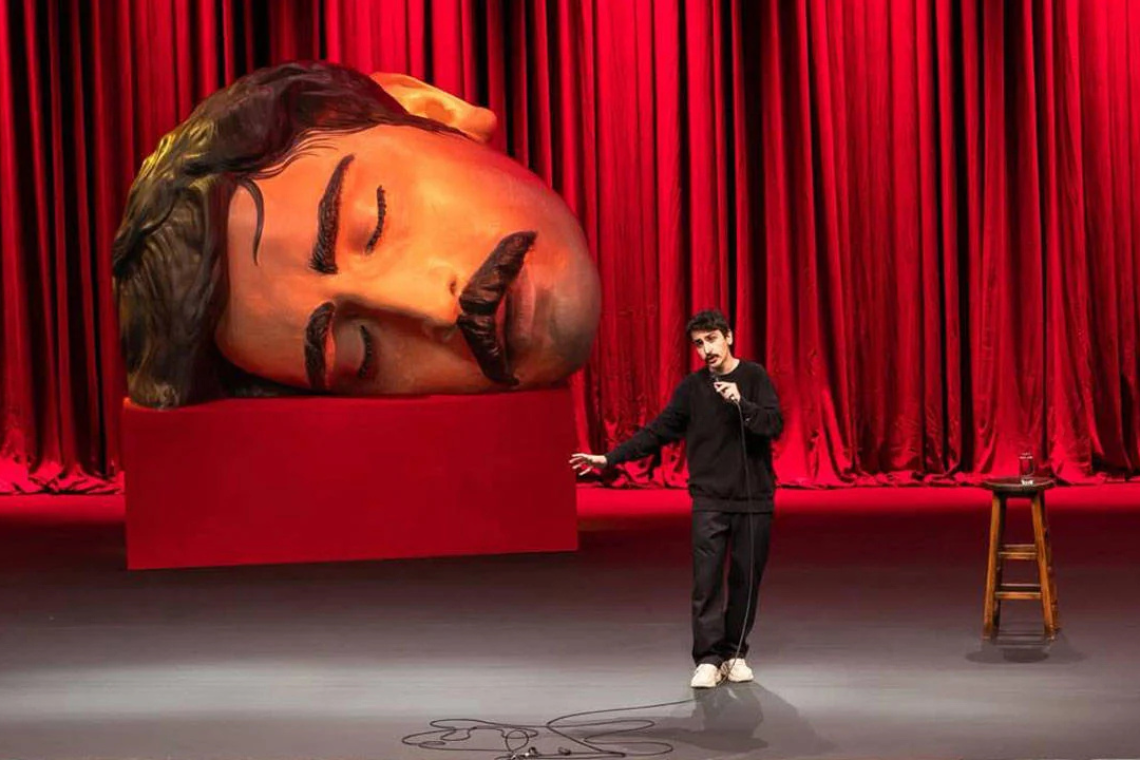
An indictment against jailed comedian Deniz Göktaş says more than 500 complaints were filed with CİMER, Turkey’s Presidential Communication Center, over his stand-up show “Ölü Deniz” (“Dead Sea”).
In addition to the CİMER complaints, 11 individuals reported Göktaş to the authorities, as did the Union of Spiritual, Principled and Merit-Based Religious Affairs and Foundation Employees.
The prosecutor cited the more than 500 applications as evidence for the claim that Göktaş’ jokes were “capable of causing public outrage among broad sections of society.”
President Recep Tayyip Erdoğan is the sole complainant named in the indictment.
Semra Pelek
The indictment against comedian Deniz Göktaş, who has been held in pretrial detention for 63 days at Çorlu Karatepe High Security Prison in northwestern Turkey, has been completed.
Göktaş was arrested over jokes he made during his stand-up show “Ölü Deniz” (“Dead Sea”). But the indictment suggests that understanding what led to his prosecution requires looking less at the stage than at CİMER, Turkey’s Presidential Communication Center, which receives complaints and petitions from the public.
According to the indictment, more than 500 CİMER applications were filed over the show, along with 12 tip-offs, one of them from a religious workers’ union.
Prosecutors cited the volume of those complaints as a basis for their assessment that Göktaş’ remarks were “capable of causing public outrage among broad sections of society.”
Göktaş is being held at Çorlu Karatepe, a high-security prison critics refer to as a “pit-type” facility because of its architecture and restrictive detention conditions.
More than 500 submissions and 12 complaints
The indictment does not provide a detailed breakdown of the submissions made against Göktaş. It does not identify those who contacted CİMER, Turkey’s Presidential Communication Center, say how many submissions concerned the same remarks or explain which submissions were used as the basis for particular charges. Prosecutors nevertheless cite the number of submissions in assessing the impact of Göktaş’s remarks on society.
The indictment names 11 individuals and one labor union as having filed complaints against Göktaş. One of them is the Union of Spiritual, Principled and Merit-Based Religious Affairs and Foundations Employees (MİL-DİYANET SEN).
The union says on its website that it advocates for the economic, social and professional rights of employees of Turkey’s Presidency of Religious Affairs, known as the Diyanet, and the General Directorate of Foundations. It also says it embraces a model of unionism committed to “national, principled and spiritual values” and opposes what it describes as the “tutelage and yoke” of political parties.
Celaleddin Gül, the union’s president, founded MİL-DİYANET SEN in 2019. Gül, who has held various positions at the Presidency of Religious Affairs, continues to serve as the union’s president.
In April this year, a concert by prominent rapper Lvbel C5 was canceled following a submission by MİL-DİYANET SEN. Gül said at the time, “We did not remain silent in the face of events that disregard our social values; we did what was necessary.”
MİL-DİYANET SEN also issued strongly worded statements in May over a concert by the group Manifest that had been authorized by the Gaziantep Metropolitan Municipality in Gaziantep, a major city in southeastern Turkey.
The indictment, however, does not specify which of Göktaş’s remarks prompted the union to file its complaint.
Jokes cited in the charges
The charges brought against Göktaş are based not on his show as a whole but on specific jokes. Prosecutors cite his joke about the “Daltons” as the basis for a charge of “praising crime and criminals,” while a “diver” joke about women wearing full-coverage modest swimsuits and a reference to “suicide bombers who fast” form the basis of a charge of “publicly inciting hatred and hostility.” His remarks about President Recep Tayyip Erdoğan are cited in support of a separate charge of “insulting the president.”
Prosecutors argue that the jokes cited in the indictment were “capable of causing public outrage among broad sections of society,” pointing to more than 500 applications filed with CİMER, Turkey’s Presidential Communication Center, as well as formal complaint petitions.
Göktaş’ descriptions of Erdoğan as “a shy dictator” and his reference to “a transition to a dictator who is at peace with his own identity” form the basis of the third charge in the case.
Prosecutors argue that the remarks went beyond the bounds of political criticism and damaged Erdoğan’s honor, dignity and reputation. The indictment thus treats political satire delivered during a comedy show as grounds for prosecution under Article 299 of the Turkish Penal Code, which criminalizes “insulting the president.”
Erdoğan is also the sole complainant named in the indictment.
Prosecutor acknowledges freedom of expression, then draws its limits
One notable section of the indictment is the prosecutor’s lengthy assessment of freedom of expression. Citing Article 26 of Turkey’s Constitution and the European Convention on Human Rights, the prosecutor acknowledges that freedom of expression is one of the fundamental elements of a democratic society.
The indictment goes further, stating that freedom of expression applies not only to ideas that are accepted by society or regarded as harmless, but also to those that are “offensive, shocking or disturbing.”
It then turns to the limits of that protection. In Göktaş’ case, prosecutors argue that those limits were exceeded.
The case therefore raises questions beyond which jokes led to criminal charges against a comedian. On one side is an indictment acknowledging that freedom of expression also protects speech that is “offensive, shocking or disturbing.” On the other are several comedy jokes that prosecutors say fall outside that protection, with hundreds of CİMER complaints cited as evidence of their impact on society.