

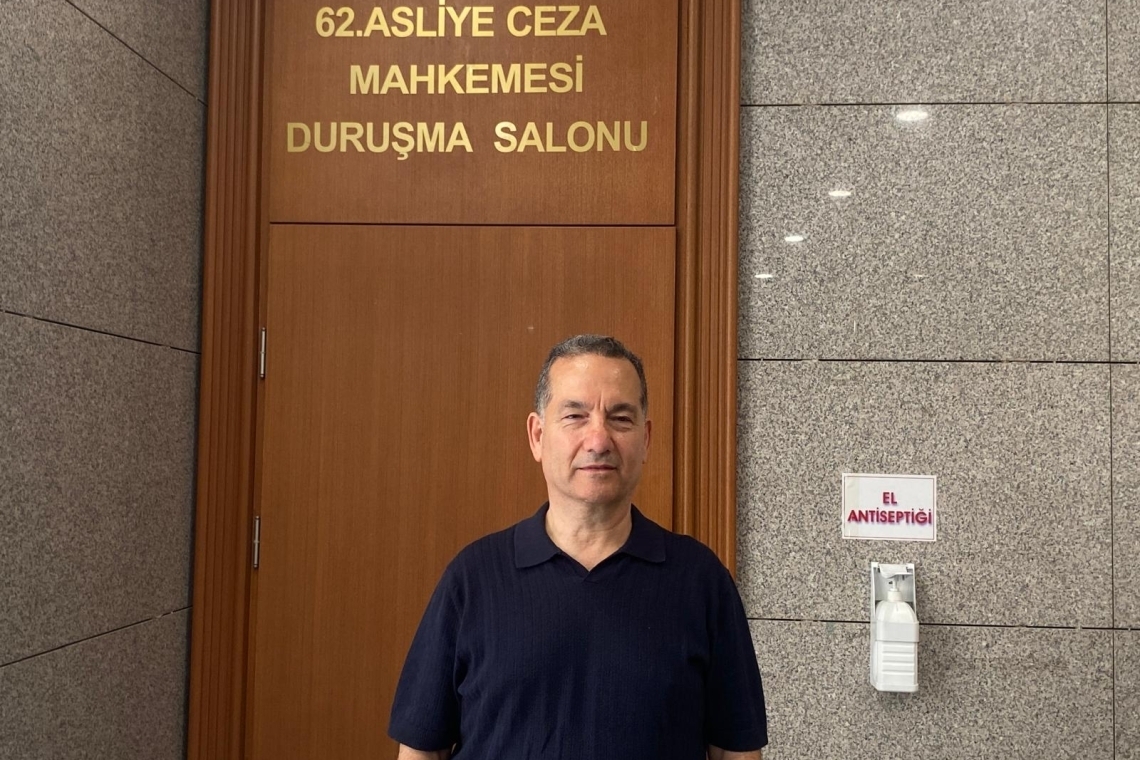
In the trial of five police officers, including two commissioners, accused of beating lawyer Murat Çelik and detaining him with his hands cuffed behind his back during a Saturday Mothers protest, on charges of "exceeding the limits of the authority to use force" and "intentional injury," the audio recordings of the officers' defense statements have been "missing" for nearly nine months.
Çelik's lawyers have requested the defense statements given by the police officers via Turkey's Audio and Visual Information System (SEGBİS) at the second hearing on four separate occasions. A court-appointed expert determined that "video footage exists" but that "audio was not recorded." The trial has made no progress since February.
Semra PELEK
The trial of five police officers, including two commissioners, accused of beating and handcuffing lawyer Murat Çelik behind his back during the Saturday Mothers' 954th weekly protest at Galatasaray Square in Istanbul on July 8, 2023, has been marred by problems raising concerns about the right to a fair trial, including inadequate courtrooms, delayed hearings and changes of judges.
For nearly nine months, the court has been unable to locate the audio portion of recordings made through Turkey's Audio and Visual Information System (SEGBİS) of the police officers' defense statements at the trial's second hearing.
The fourth hearing in the case was held at the Istanbul 76th Criminal Court of First Instance on Oct. 9. Because the presiding judge was absent for an excused reason, the hearing was conducted based solely on the case file, in a procedural practice known in Turkey as an "open-and-close" hearing, in which proceedings are formally opened and promptly adjourned without substantive consideration of the case.
Çelik's lawyers did not attend the hearing and requested a postponement, arguing that, at this stage of the proceedings, it was essential for the case to move forward before the judge with proper jurisdiction and authority.
In a petition submitted to the court, the lawyers pointed out that similar problems had occurred at previous hearings. They noted that the third hearing had also been presided over by a temporarily assigned judge, preventing substantive progress both during hearings and in the periods between them.
The lawyers asked the court to enforce an earlier interim ruling aimed at locating the audio recordings from the second hearing. They requested that the recordings be identified on the main computer, exported and transcribed. If the recordings could not be located, they called for the necessary legal and procedural steps to be taken based on the reason for their absence.
If it was definitively established that the audio recordings could not be recovered, the lawyers requested compulsory appearance orders for the defendant police officers so that their questioning and defense statements could be heard again.
They also asked for the SEGBİS recordings from the third hearing on June 26 to be transcribed and for a new hearing to be scheduled as soon as possible.
The next hearing was scheduled for Dec. 18 at 10 a.m.
The Saturday Mothers are a group of relatives of people who disappeared in police custody or under suspicious circumstances in Turkey, particularly during the 1990s. They have held weekly demonstrations in Istanbul's Galatasaray Square to demand answers about the fate of their missing loved ones and accountability for those responsible.
Police officers give defense statements at second hearing, but audio recording goes missing
The second hearing in the case was held on Feb. 18, 2026. Four of the defendant police officers — Commissioner Ali H. and police officers Burak Mehmet Ç., Fatih A. and Zahir K. — attended the hearing and delivered their defense statements. The defense statement of the other commissioner, İlhan Ç., was taken separately in Erzurum, a city in eastern Turkey, under a judicial assistance request between hearings.
The officers' questioning was recorded through Turkey's Audio and Visual Information System (SEGBİS). However, an expert report submitted to the case file at the third hearing on June 26 revealed that approximately 90 minutes of the 2-hour, 18-minute recording had no audio. The expert found that video footage was available but that the audio had not been recorded.
Çelik's lawyers requested that the court contact the Turkish Justice Ministry's Information Technology Department and other relevant technical units to locate the missing recordings.
The court subsequently ordered inquiries to be sent to the relevant authorities to determine what had happened to the recordings and to ensure that any existing recordings were transcribed and preserved.
However, according to a petition submitted by Çelik's lawyers on Oct. 9, efforts to recover the missing recordings had yielded no results.
What did the police officers say?
At the second hearing, where a substantial portion of the audio recording is now missing, the defendant police officers defended their actions against Çelik, claiming they had not intended to injure him.
Commissioner Ali H. said the Saturday Mothers' protest on July 8, 2023, had been banned under orders issued by the governor's office and district governor's office, and that force had been used against people who resisted at the protest site. Ali H. acknowledged using force while detaining Çelik but denied the charge of intentional injury.
Çelik, however, identified Ali H. as the police officer who kicked him while he was on the ground, insulted him after handcuffing him behind his back and threatened to break his arm.
Defendant police officer Zahir K. also defended his actions, saying he had followed orders from his superiors. Responding to questions from the lawyers, Zahir K. said, "Whether the legal conditions for an arrest are met is not my concern. My superiors give orders, and I carry them out." He maintained that he had merely been performing his duties during the detention.
Çelik, meanwhile, said the violence began after Zahir K. told him, "Now you'll see what the police are capable of. You'll see what the state is capable of."
Police officer Burak Mehmet Ç. argued that he had not personally carried out Çelik's detention and therefore could not have injured him. Another defendant, police officer Fatih A., said he had been inside a vehicle during the detention and had not witnessed the officers' intervention.
In their defense statements concerning the video footage, the defendant police officers offered little beyond insisting, "We had no intention of injuring him."
Judges change, hearings start late
Problems affecting the trial have not been limited to the missing audio recordings. The third hearing, held on June 26, began 2 1/2 hours late because the presiding judge had been replaced and no new judge had been appointed.
A temporary judge from within the courthouse was assigned to preside over the hearing, which had been scheduled for 10 a.m. However, a technical malfunction with the SEGBİS connection caused further delays, and proceedings did not begin until 12:30 p.m. in the courtroom of the 55th Criminal Court of First Instance.
Lawyers attending the hearing also criticized the courtroom's inadequate facilities. Speaking on behalf of the Union of Turkish Bar Associations, lawyer İlknur Alcan said forcing lawyers to stand throughout the hearing raised concerns about the right to a fair trial and requested that proceedings be moved to a larger courtroom.
Çelik says torture marks found on 33 parts of his body
Speaking at the third hearing, Murat Çelik said a report prepared by the Human Rights Foundation of Turkey had documented signs of torture on 33 parts of his body. Çelik, who said he had been undergoing medical treatment for three years, also revealed that one of the police officers he accused of directly assaulting him had been appointed as a chief commissioner in Erzurum, a city in eastern Turkey.
Çelik also told the court that he had been at risk of suffering a brain hemorrhage at the hospital on the day of his detention but had received no medical intervention and was made to wait more than three hours for a CT scan.
Çelik's lawyers are seeking a reassessment of the legal classification of the alleged offenses and want the case transferred to a High Criminal Court. They argue that the officers' actions should be prosecuted as "torture," citing the fact that Çelik was detained and subjected to violence despite explicitly identifying himself as a lawyer.
The fourth hearing ended without resolving the uncertainty surrounding the missing audio recordings. Questions remain about why the recordings of the police officers' defense statements contain no audio and whether the missing audio can be recovered.