

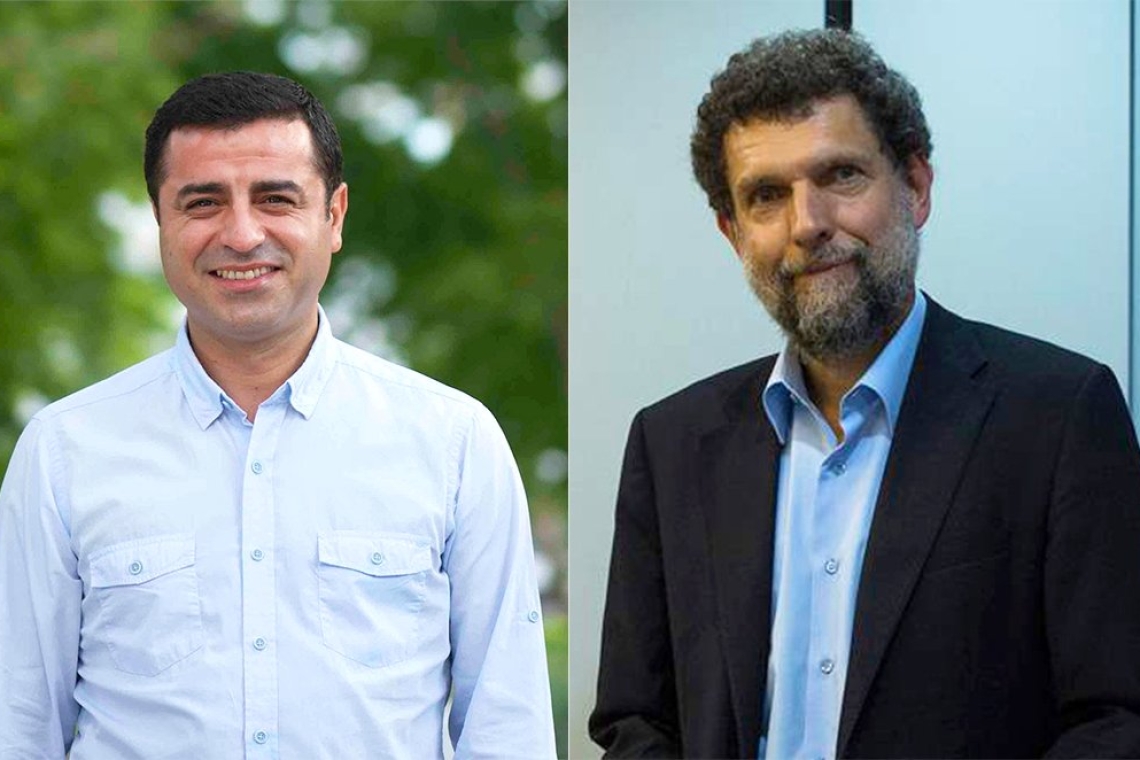
MLSA has submitted a Rule 9.2 communication on the cases of Osman Kavala and Selahattin Demirtaş to the Council of Europe mechanism that supervises the implementation of European Court of Human Rights (ECHR) judgments. The communication states that, despite the ECHR's rulings, arbitrary detentions of journalists, human rights defenders, and citizens exercising their rights to freedom of expression and peaceful assembly continue in Turkey.
The Media and Law Studies Association (MLSA) has submitted a Rule 9.2 communication on the cases of Osman Kavala and Selahattin Demirtaş to the Council of Europe mechanism that monitors whether member states comply with European Court of Human Rights (ECHR) judgments. Rule 9.2 allows civil society organizations to submit their views to the Committee of Ministers.
In the communication, submitted for consideration at the Council of Europe Committee of Ministers' Sept. 17-20 meeting, MLSA said the violations identified by the ECHR in its Osman Kavala and Selahattin Demirtaş judgments have not been remedied. On the contrary, it said the practice of arbitrarily detaining people for exercising their protected rights continues.
"Systemic problem persists"
The communication states that Turkey's Criminal Judgeships of Peace continue to order detentions without adequately establishing the link between the evidence in case files and the accusations. It emphasizes that pretrial detention has ceased to be an exceptional measure and has instead become a tool of pressure, particularly against people exercising their rights to freedom of expression and peaceful assembly.
It says that many people have been detained over journalistic activities, social media posts, participation in protests, artistic expression, and statements critical of the government.
Recent cases cited as examples
MLSA also included numerous recent investigations and detention cases in its communication. Among those cited were journalist Yıldız Tar, who was detained on charges of "membership in a terrorist organization" over journalistic activities; journalist Alican Uludağ, who was detained over social media posts; and journalist Furkan Karabay, who was detained over his news reports on the investigation targeting Ekrem İmamoğlu.
The communication also highlighted the cases of journalist Fatih Altaylı, who was detained over remarks made during a YouTube broadcast; journalist İsmail Saymaz, who was placed under house arrest over his reporting on the Gezi Park protests; cartoonist Doğan Pehlevan, graphic designer Cebrail Okçu, news editor Zafer Aknar, and manager Ali Yavuz, who were detained over a cartoon published in LeMan magazine; journalists and students detained during protests over İmamoğlu's arrest; and youth and LGBTI+ rights defender Enes Hocaoğulları, who was detained after delivering a speech at the Council of Europe.
The communication states that these examples affect not only the right to liberty and security but also freedom of expression, press freedom, and the right to peaceful assembly.
MLSA called on the Council of Europe Committee of Ministers to continue supervising the implementation of the Osman Kavala and Selahattin Demirtaş judgments and to urge Turkey to take concrete steps to prevent arbitrary detentions.
The communication also calls for pretrial detention to be used only where there is reasonable suspicion based on strong evidence, for the structure of the Criminal Judgeships of Peace to be reviewed, for the release of those detained over activities protected by freedom of expression, and for the government to submit a detailed action plan addressing these issues.
Background
The Council of Europe Committee of Ministers supervises whether member states implement judgments of the European Court of Human Rights (ECHR). Under its Rule 9.2 procedure, civil society organizations are allowed to submit information and observations regarding ongoing supervision of the implementation of ECHR judgments.
The ECHR has ruled in the cases of Osman Kavala and Selahattin Demirtaş that Turkey violated their right to liberty and security and that their detentions were not based on a reasonable suspicion supported by sufficient evidence. The Council of Europe Committee of Ministers continues to monitor the implementation of those judgments under its enhanced supervision procedure.