

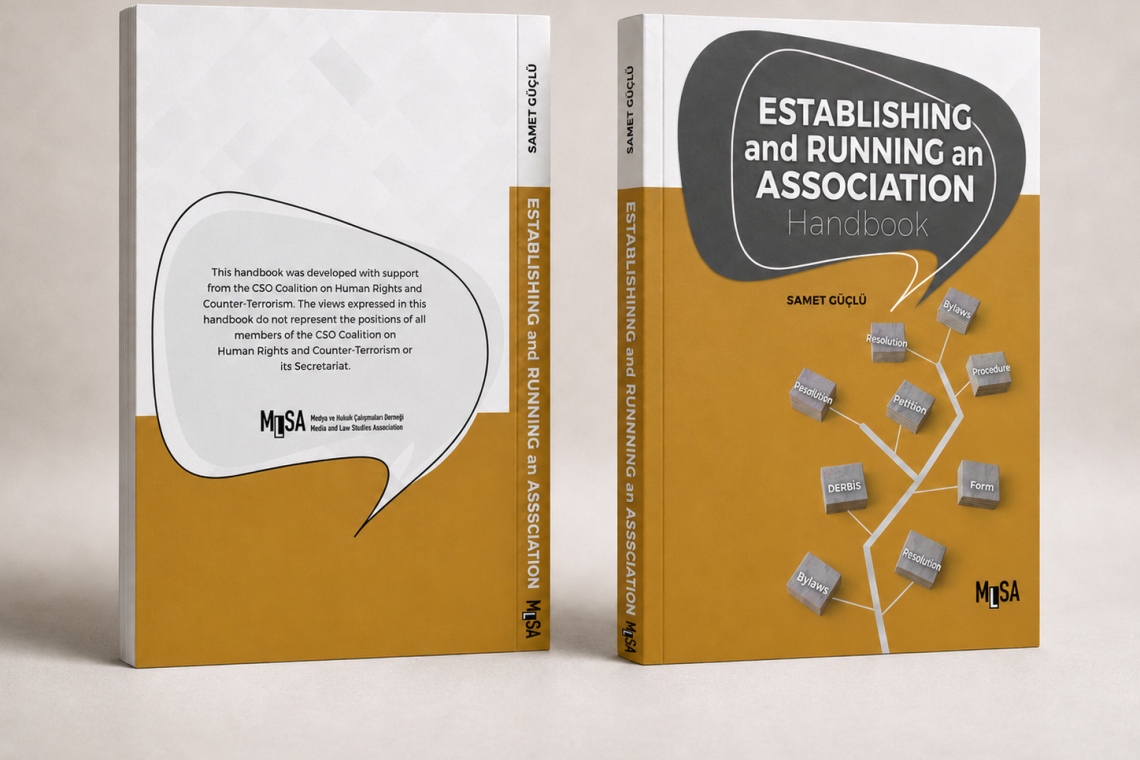
The Media and Law Studies Association’s (MLSA) new publication, “Guide to Establishing and Running an Association,” brings together key information and documents that civil society organizations may need, from the process of setting up an association to its day-to-day administrative and financial operations.
The guide was prepared as one of the outputs of MLSA’s “Financial Oversight and Civil Society in Turkey: Research and Guidance for NGOs” project. The project was implemented with support from the David and Lucile Packard Foundation through the Secretariat of the CSO Coalition on Human Rights and Counter-Terrorism, which operates within Saferworld USA.
Prepared at a time when civil society organizations in Turkey are facing increasingly burdensome and unpredictable financial and administrative oversight, the publication aims to strengthen NGOs’ capacity to comply with regulations and help them better prepare for possible audits and inspections.
As part of the project, MLSA examined the framework of the Financial Action Task Force (FATF), the international body that sets standards for combating money laundering and terrorist financing, as well as Turkey’s regulations governing oversight of civil society organizations. A field study was also conducted to document the inspection experiences of civil society groups working in different areas. The findings were discussed at a roundtable meeting in Istanbul, Turkey’s largest city, with representatives of civil society organizations, lawyers and funding organizations.
Prepared by MLSA, the guide takes a practical approach to the key documents and procedures required from the establishment of an association through its daily operations. It includes sample bylaws, petitions, resolutions and forms, as well as guidance on risk management, procurement, finance and fixed-asset procedures, an anti-corruption policy and explanations on the use of DERBİS, Turkey’s online information system for associations.
Through the publication, MLSA aims to help civil society organizations strengthen their institutional operations, better understand their rights and obligations, and manage any audits or inspections they may face in a legally compliant and well-prepared manner.