

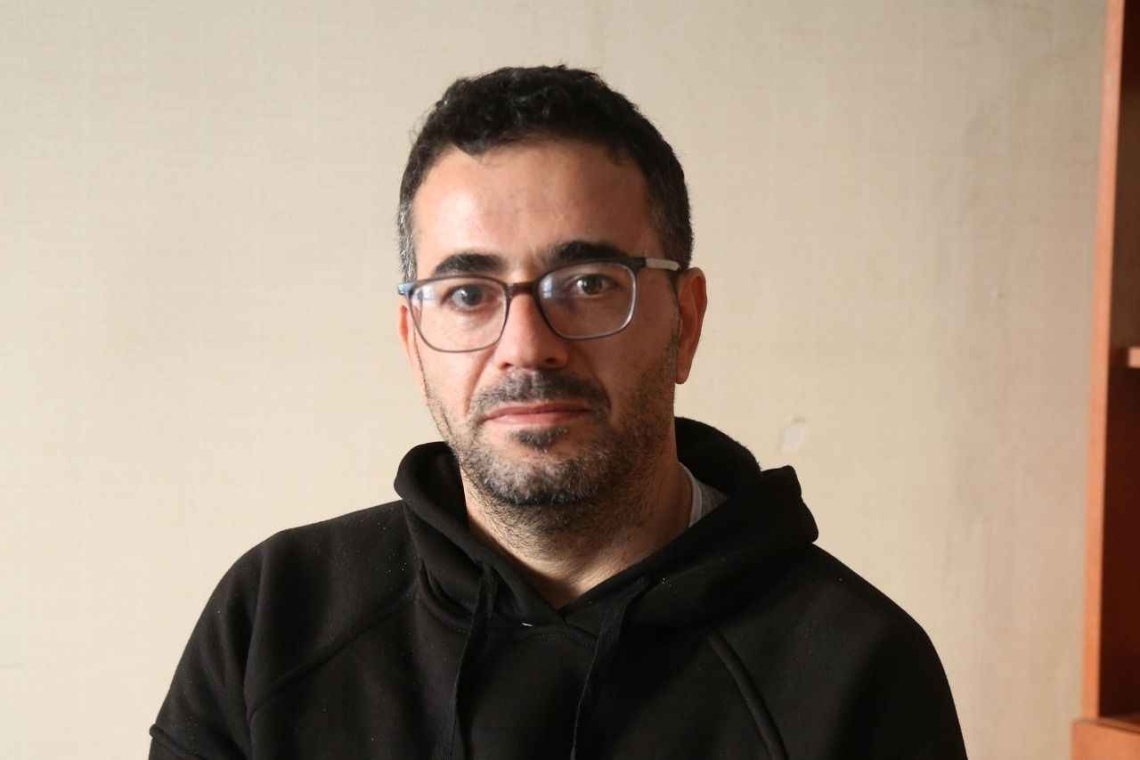
- The Media and Law Studies Association (MLSA) Legal Unit has filed an individual application with Turkey’s Constitutional Court challenging a fine imposed on journalist İdris Yılmaz for “insult” after a yearslong trial. Yılmaz was detained in 2015 while trying to cover a funeral in the Erciş district of Van province in eastern Turkey.
- The application argues that Yılmaz’s conviction violated his rights to a fair trial and a reasoned judgment, as well as his freedoms of expression and the press.
The Media and Law Studies Association (MLSA) Legal Unit, which is representing journalist İdris Yılmaz, filed an individual application with Turkey’s Constitutional Court on his behalf. The application argues that Yılmaz’s conviction for insult, in a case brought after he was detained while trying to report on an incident at a condolence house in Erciş in 2015, violated the principles of equality of arms and adversarial proceedings under the right to a fair trial, as well as his right to a reasoned judgment and freedom of expression.
The incident took place on Nov. 6, 2015, at a condolence house operated by Erciş Municipality in the Yeşilova neighborhood of Erciş, a district of Van province in eastern Turkey. Yılmaz, who was trying to record footage, was confronted by law enforcement officers and taken into custody at a police station. A medical examination carried out the same day found signs of physical assault and force on his body.
Yılmaz filed a complaint against the law enforcement officers he said had assaulted and insulted him. The police officers who were on duty during the incident filed a countercomplaint, alleging that Yılmaz had insulted and threatened them and resisted during his detention.
Yılmaz gave a statement to the Van Chief Public Prosecutor’s Office on Jan. 4, 2016, as a complainant, saying he had been beaten by plainclothes police officers while in custody. He also said police officers in Erciş had assaulted him a week earlier while he was covering another funeral. Yılmaz asked prosecutors to examine police camera footage and recordings made by other journalists to identify those responsible. On Jan. 8, 2016, he gave another statement, this time as a suspect, and denied the allegations against him.
The Erciş Chief Public Prosecutor’s Office filed an indictment on Aug. 16, 2016, charging Yılmaz with “resisting a public officer to prevent the performance of duty,” “insult” and “threat.” At a hearing on Jan. 17, 2017, Yılmaz said he had gone to the scene as part of his journalistic work, had neither insulted nor resisted law enforcement officers and had himself been assaulted. He again requested that police camera footage be examined.
The Erciş 1st Criminal Court of First Instance on Sept. 21, 2017, sentenced Yılmaz to one year and three months in prison on each of the charges of resisting a public officer to prevent the performance of duty and insult. The court acquitted him of the threat charge.
Yılmaz challenged the final conviction again in 2019, taking advantage of a change in the law. In his appeal, he reiterated that footage from a police camera had never been added to the case file despite his repeated requests and argued that examining the footage would reveal what had actually happened.
At the end of 2024, the 4th Criminal Chamber of Turkey’s Court of Cassation overturned the ruling on the insult charge, and the case was sent back to the Erciş 1st Criminal Court of First Instance.
At a hearing in the summer of 2025, Yılmaz and his lawyer again asked the court to obtain the police camera footage or, if it was no longer available, footage from the MOBESE municipal surveillance camera system. They said the video recordings already in the case file were unrelated to the incident. The court rejected the request.
At the final hearing on July 8, the court convicted Yılmaz only of insult and imposed a fine of 8,840 Turkish liras.
“Law enforcement camera footage was not examined”
The application said that law enforcement camera footage, which Yılmaz had consistently asked the court to obtain throughout the proceedings, was never added to the case file at any stage.
The MLSA Legal Unit emphasized that the recordings constituted evidence accessible only to law enforcement and that the failure to examine them deprived the defense of an opportunity to challenge the statements of police officers that formed the basis of Yılmaz’s conviction.
The application also said the final judgment failed to specify which camera footage the court had relied on.
“Right to a reasoned judgment was violated”
The application said that conflicting statements concerning whether Article 129 of the Turkish Penal Code, which addresses unjust provocation, should apply — an issue highlighted in the Court of Cassation’s ruling overturning the conviction — were not examined during the retrial.
The MLSA Legal Unit argued that the court’s failure to address these objections, which could have affected the outcome of the case, with relevant and sufficient reasoning violated Yılmaz’s right to a reasoned judgment.
“Convicted over journalistic activity”
The application said Yılmaz went to the scene on the day of the incident to report on an event of public interest, showed his press card and was subjected to law enforcement intervention while carrying out his journalistic work. The MLSA Legal Unit stressed that journalists’ coverage of events of public interest, including gathering information and images, is protected by freedom of expression and freedom of the press, and that those protections extend not only to published news reports but also to preliminary newsgathering activities such as being present at the scene.
The application cited the Constitutional Court’s rulings in the cases of Erdal İmrek and Beyza Kural Yılancı, in which the court examined law enforcement interventions that obstructed journalists covering public demonstrations and other events under Articles 26 and 28 of the Turkish Constitution. The MLSA Legal Unit said the lower courts had failed to assess Yılmaz’s defense that he was at the scene in his capacity as a journalist and that his work served the public’s right to be informed. It argued that this could have a chilling effect not only on Yılmaz but also on other journalists covering similar events.
The application asked the Constitutional Court to find violations of the principles of equality of arms and adversarial proceedings and the right to a reasoned judgment, which are protected as part of the right to a fair trial under Article 36 of the Constitution, as well as freedom of expression and freedom of the press guaranteed under Articles 26 and 28 of the Constitution and Article 10 of the European Convention on Human Rights.