

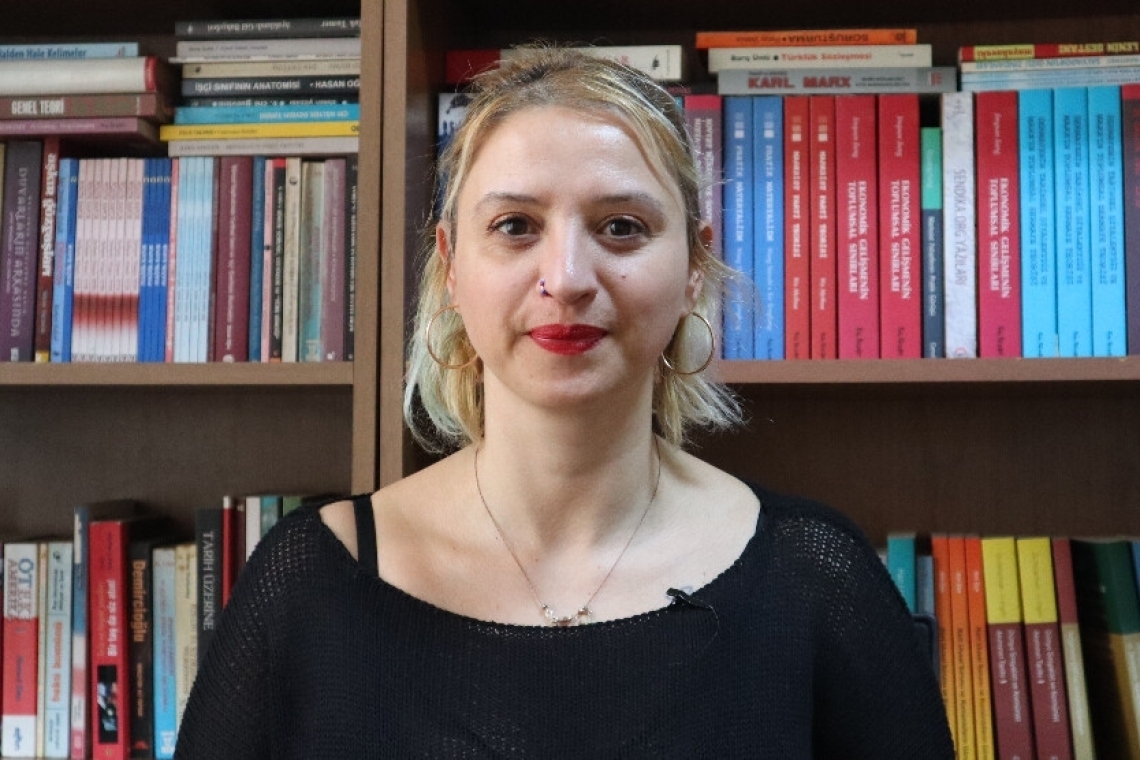
- A court ordered the release of journalist Pınar Gayıp, who had been held in pretrial detention for more than seven months, at the first hearing of her trial on a charge of “membership in an organization.” Gayıp is represented by the Media and Law Studies Association (MLSA).
- Mustafa Tezel, one of the witnesses whose statements were cited in the indictment as evidence against Gayıp, told the court that he had not made such a statement and did not know Gayıp.
- Two other witnesses said they had seen Gayıp taking photographs but did not know anything else about her.
- The court ordered that a travel ban preventing Gayıp from leaving Turkey remain in place and adjourned the trial until Dec. 7 at 10:15 a.m.
MLSA — The first hearing in the trial of journalist Pınar Gayıp on a charge of “membership in an organization” was held at the Istanbul 23rd High Criminal Court. The court ordered the release of Gayıp, who had been in pretrial detention for more than seven months, and adjourned the trial until Dec. 7.
Gayıp was brought to the hearing from Bakırköy Women’s Prison in Istanbul, where she had been held. She was represented by attorney Emine Özhasar, coordinator of MLSA’s Legal Unit.
Gayıp began her defense statement by thanking fellow journalists who had supported her.
“I would like to thank my journalist colleagues who supported me in an environment where we, as journalists, are being prosecuted even over money we send one another to pay for tea,” she said.
“Why, then, do we revolutionary and socialist journalists stand in solidarity with one another?” Gayıp asked, saying she was being prosecuted over her journalistic activities.
“Is it because we do our work without straying from the ethical principles of journalism and without compromising the truth? For journalists, reporting the news has become an extremely perilous undertaking. Musa Anter, Metin Göktepe, Hrant Dink and Kadri Bağdu were killed for reporting on what happened during the dark years of the 1990s. More recently, Nazım Daştan and Cihan Bilgin, journalists who followed in the footsteps of those who built the tradition of the free press, were killed while reporting the realities of a war zone,” she said.
“I have been jailed on the lies of a child abuser”
Gayıp said she was harassed by female police officers while in custody and was kept under surveillance even while using the toilet.
“I have to fight even for my right to use the toilet,” Gayıp said, adding that she was jailed without ever appearing before a prosecutor.
Gayıp said she was being tried on the basis of an indictment only a few pages long and noted that the case file included statements from 10 informants.
“Who am I that there are 10 informants against me?” she asked.
Gayıp said all of the informants had essentially made the same claim about her.
“What did all the informants say? That I work at ETHA. I do work at ETHA, and for years I have been telling courts that I work at ETHA,” she said, referring to the Etkin News Agency, a Turkey-based news outlet.
Gayıp said she would not address each of informant Mustafa Bozali’s statements individually, adding that she had first heard his name at a news conference held at the Istanbul branch and did not know him personally.
She said she had written news reports about allegations of child abuse involving Bozali.
“I am someone who fights for the best interests of children, yet today I have been jailed for months because of the lies of a child abuser,” Gayıp said.
“Social media posts treated as evidence of a crime”
Gayıp said journalists keep their social media accounts public so their news reports can reach a wider audience. She said all of her social media accounts had been publicly accessible for years and that she shared her reporting both through ETHA and on her own accounts, but those posts were presented in the case file as evidence of criminal activity.
“These posts were treated as crimes and presented as though they had been uncovered through some special investigation,” Gayıp said. “They were placed in the case file as if they had been obtained through a forensic examination. Even my having a press card, which every journalist is required to display transparently, was treated as a crime.”
Gayıp also said her coverage of the Saturday Mothers’ protests was cited in the case file as evidence against her.
At the end of her defense statement, she asked the court to order her release and acquit her.
Witnesses do not corroborate statements accusing Gayıp
A witness identified as Arda testified at the hearing via SEGBİS, Turkey’s judicial videoconferencing system. The witness, whose earlier statement accused Gayıp of “membership in an organization,” told the court under questioning from the judge that he had seen her taking photographs at a March 12 commemoration.
The judge asked, “Did you see her chanting slogans or taking part in the demonstration?”
“No, I only saw her taking photographs at demonstrations,” the witness replied.
Another witness, Mustafa Tezel, then testified. Although the indictment cited Tezel as accusing Gayıp of “membership in an organization,” he told the court that he did not know Gayıp and had never seen her. Tezel also said the statement attributed to him in the indictment was not his.
An anonymous witness then testified via SEGBİS, with the witness’s voice and image altered to conceal their identity. The witness said they had known Gayıp since 2015 or 2016.
The judge asked the anonymous witness, “Did you see Pınar Gayıp taking part in demonstrations or clashing with police?”
“Pınar Gayıp was carrying out journalistic activities,” the witness replied.
Özhasar: Gayıp’s profession made the subject of criminal allegations
Following the witness testimony, attorney Emine Özhasar, coordinator of MLSA’s Legal Unit, began her defense statement.
Özhasar said Gayıp had worked as a journalist for 10 years, holding various positions at ETHA ranging from reporter to editor, and had also worked for several local and digital news outlets. She said the defense’s central objection was that Gayıp’s journalistic activities had themselves been made the subject of criminal allegations.
“Working for a particular institution or taking part in a particular event does not have the same legal meaning as being part of the hierarchical structure of an armed organization,” Özhasar said.
Özhasar said that, in order to establish membership in an organization, prosecutors must demonstrate a person’s concrete position within the organization’s hierarchy, rather than merely whether that person worked for a particular media outlet.
She said this required establishing who the person received instructions from, what instructions they carried out, how they participated in the organization’s decision-making mechanisms, what specific illegal activities they conducted on behalf of the organization and how those activities were connected to the organization’s objectives.
Özhasar said the investigation into Gayıp had not begun over a specific alleged criminal act, but that she had instead been added to the case as part of a broad investigation without any specific and individualized act being identified in advance.
“In investigations conducted against large numbers of people using the same organizational template, the actions of each defendant must be examined independently and on an individualized basis,” Özhasar said, also citing the Constitutional Court’s ruling in the case of Cemil Uğur.
Özhasar quoted the following passage from the ruling:
“...the mere fact of working at such a news agency cannot, without taking into account the content of the news reports produced by the applicant, be regarded on its own as strong evidence of a terrorism-related offense. ... It is clear that the applicant ... cannot be held responsible for all news reports produced by the agency.”
“No organizational instructions were presented”
Özhasar said the case file failed to establish a distinction between Gayıp’s journalistic activities and alleged organizational activity.
“The prosecution has not shown which news report my client prepared under organizational instructions, which content she published following a central decision by the organization, which editorial decision involved her carrying out a hierarchical instruction from the organization, who gave her instructions, or to whom she gave organizational instructions,” Özhasar said.
She said logging into ETHA’s account, relaying information to the newsroom or publishing news reports were all part of carrying out the profession of journalism. If prosecutors maintained that such activities had an organizational character, she said, that claim had to be separately explained and supported with concrete evidence.
Press card and coverage of the Saturday Mothers
Özhasar said an ETHA press card issued in Gayıp’s name had also been presented as evidence against her.
“The existence of a press card supports my client’s identity as a journalist, not the allegation that she is a member of an organization,” Özhasar said. “It is entirely ordinary for a journalist to carry a press card issued by the news agency they work for in order to cover news events.”
Özhasar said Gayıp had covered demonstrations, funerals and other events in her capacity as a journalist. Citing the European Convention on Human Rights and rulings by the European Court of Human Rights, she said journalists serve as “public watchdogs” and cannot be prosecuted merely for covering news events.
Defense points to witness statements
Özhasar said some witness statements described Gayıp as a “person in charge,” “Turkey coordinator” or “İzmir coordinator.” She said the basis for those descriptions needed to be established.
“Did the witness infer this title from a specific incident they personally observed, did they hear it from someone else, or are they simply offering their own assessment?” Özhasar said.
Özhasar also said statements given by witnesses under Turkey’s effective remorse provisions, which can allow suspects or defendants to receive reduced sentences in exchange for cooperation, should be treated with caution in line with established Court of Cassation case law and should not form the basis of a judgment.
“Communication with 327 people does not prove organizational ties”
Özhasar said HTS records, which show telecommunications traffic data, indicated that Gayıp had communicated with 327 people who had previously been investigated or prosecuted for terrorism-related offenses.
She argued, however, that the number of contacts alone did not prove an organizational connection.
“The fact that people someone has spoken to were previously investigated does not automatically make the content of those conversations organizational in nature,” Özhasar said.
She raised a series of questions about the HTS records: “Who did my client speak to? What did they talk about? Which part contains evidence of a crime? None of that is there.”
Money transfers and Google Meet meeting
Özhasar said data from Turkey’s Financial Crimes Investigation Board (MASAK) also failed to demonstrate that Gayıp was a member of an organization.
“For a money transfer to constitute evidence of a crime, its purpose, source, description, amount, timing and connection to organizational activity must be established,” Özhasar said.
She said a significant portion of the transfers in the case file involved small sums exchanged with journalist colleagues or people in Gayıp’s social circle. She added that bank transfer records included descriptions such as “debt” and “house rent.”
Özhasar also said no factual or technical link had been established regarding the allegation that Gayıp took part in a Google Meet meeting.
“The fact that a username contains the name ‘Pınar’ does not technically prove that the account belongs to my client,” Özhasar said.
She added that even if Gayıp were assumed to have attended the meeting, prosecutors would still need to establish what was discussed, whether she received any instructions, whether she took part in making any decision or whether she was assigned any specific task.
“No direct and automatic link can be drawn between the allegation that she attended a meeting and membership in an organization,” Özhasar said.
Hunger strike also cited as evidence
Özhasar said Gayıp’s decision to go on hunger strike while in police custody was also characterized in the indictment as an “organizational stance.”
She argued that going on hunger strike to protest detention conditions fell within the scope of freedom of expression and said the evidence in the case file did not establish that Gayıp was a member of an organization.
“In a case file containing this many doubts, not only would continued detention be unlawful, but there should also be no basis for a conviction,” Özhasar said.
She asked the court to order Gayıp’s release.
Gayıp released from pretrial detention
After the defense statements, the court recessed to deliberate on an interim ruling and ordered the courtroom cleared.
The court ordered Gayıp’s release subject to a ban on leaving Turkey.
The trial was adjourned until Dec. 7 at 10:15 a.m.